Friday, January 6, 2017

Familiar Mechanics

                   So here’s  list of mechanics from previous games that will make their way into “The Dark Crusade”: 

  • Fatigue: This is a mechanic that originated in Thracia 776 that was a number that increased whenever the player’s units accomplished a certain action. Once the number became greater than or equal to that unit’s max HP they would have to sit out the next chapter. Other elements of how fatigue worked in Thracia were, to quote Fire Emblem wiki:

                         “A unit's fatigue meter is reset to 0 after any chapter in which they are not deployed, regardless of what it was before. Usually, a unit's fatigue meter is only increased by 1 for each time they enter a battle, but high-level staves increase fatigue by more than 1; D-rank staves increase fatigue by 2, C-rank staves increase fatigue by 3, B-rank staves increase fatigue by 4, and A-rank and preferential staves increase fatigue by 5. This can be problematic, as most staff-wielders have a low Max HP.” (Source: http://fireemblem.wikia.com/wiki/Fatigue)

                             For my game fatigue will be handled differently, although the goal is still the same. Instead of increasing by 1 every time, there’s a set amount. For first tiers it’s 8, for second tiers it’s 10 and for third tiers it’s 12. The staff one uses no longer increases fatigue anymore than fighting does. Like Thracia, having a unit sit out resets fatigue to 0. Unlike Thracia once a unit hits fatigue here instead of being forced to sit out their stats get divided by 4, they cannot use skills of any kind and their movement is reduced. It takes just as many turns to de-fatigue as it takes to fatigue. Like Thracia there will be  items that can help the player manage fatigue. There will also be skills that can help the player do this too.


  • Third Tiers: I think everybody already knew this, but it was worth mentioning anyway. I’ve estimated this game should be around 60 - 80 chapters long so third tiers are coming back out of necessity more than anything. It also doesn’t hurt that they’re pretty cool. (Also, originated from Gaiden. Lol)


  • Capture: Another returning mechanic from Thracia 776. Here’s how Fire Emblem wiki describes it: “Characters can only capture enemies that have a smaller Build compared to them, though mounted units are exempt from this rule except while dismounted. When a battle is initiated with the intention of capture, the character's Strength, Magic, Skill, Speed and Defense are all halved, so it is advised to weaken the enemy prior to a capture attempt, unless the character is powerful enough to inflict sufficient damage regardless of stat reductions.

                          The enemy's HP must drop to zero in order for the capture to take effect. Brave weapons like Finn's Hero Lance or the skill Charge are considered very helpful in a capture attempt.

                            Once an enemy is successfully captured, the character can trade with their hostage to take anything in their inventory. They may also release the hostage, although this counts as killing them gameplay-wise (whereas just holding onto them until the chapter's end counts as if they have never been fought). Ostensibly, releasing a captured unit counts as letting them escape the battlefield with their lives intact, in relation to the story.” (Source: http://fireemblem.wikia.com/wiki/Capture


                            The same overall principle is present in “The Dark Crusade” but there are a few changes to be made. For starters, instead of simply having higher Constitution you instead need to have a Constitution that’s higher by a certain amount. Right now I’m thinking that you need to have 4 or more Constitution in order to Capture, but that may be subject to change. Another major change is that cavaliers (even when mounted) can be captured too. The third change is that when an enemy gets caught the unit’s stats aren’t halved. They’re still reduced, but not cut in half. Right now capturing enemies won’t have an effect on the unit’s item capacity (that would be ridiculous and it would make capturing not worth it).

                               The capture system is designed to replace money altogether. In my opinion almost every Fire Emblem game that gives money gives way too much of it. This gives the player way too many resources which makes the games easier and sort of undermines weapon durability. Here the capture system lets the player obtain anything that money would have been able to buy them, but forces the player to earn these things. 


  • Hidden Weapons: If you read the “Rough Draft Formula” you would have seen this one coming. However, there are some major changes to how they work. For starters they’re not all 1 - 2 range anymore. Some of them will still be, but there are a lot of 1 range daggers and knives now. There are also a few of them that don’t have one range, like blowguns. If blowguns being used as a weapon sounds silly to you may I remind that they were actually used in wars as legitimate weapons in South America and Southeast Asia (and there are countries in this game that are based on South America and Southeast Asia). You can read more about it here: https://en.wikipedia.org/wiki/Blowgun

                                           Another major change is that Hidden Weapons now have the ability to instantly negate stat buffs, except for ones given by Regalia. Once the debuff recovers the unit’s stats returned to normal, unaltered by either the previous buffs or the Hidden Weapon debuffs. This is designed to fix a major problem that Fates incurred. Now you can’t buff your characters stats into the stratosphere and be safe from any debuff that came your way. There will also be items and skills that can either negate debuffs altogether or restore debuffs or can transfer debuffs from one allied unit onto an enemy unit. The point here is that instead of solving stat debuffs via more stat-stacking the solution is about using the right tool at the right time.

                                          A lot of Hidden Weapons as a whole will also be able to inflict statuses on enemies too, more so than what most other weapons are usually capable of. The trade-off is that their might will most likely get nerfed.


  • Unlockable Gaiden Chapters: Old school Gaiden chapters like the ones in Thracia 776 or the GBA games are coming back with a vengeance! The only real change here is that the game will inform the player at the beginning of a chapter of any incoming Gaiden Chapters and what their requirements to unlock them will be.


  • Dismounting: Just like in Thracia 776 or in Fire Emblem 3 dismounting is coming back. It works pretty much the same way as it did in those games with the only exception being that units still get to use the exact same weapon that they could when they were mounted. Other than that it works the exact same way here. If you aren’t familiar with how dismounting worked in those games you can read more about it here: http://fireemblem.wikia.com/wiki/Dismount

  • The Elevation Mechanic / Height Bonus: This mechanic originated in Radiant Dawn. If a unit attacked another unit from a higher elevation their attack and accuracy would be increased. That still applies in this game although the accuracy boost is dropped from + 50 in Radiant Dawn to + 20 here. 


    • Branched Promotions: When a first tier unit promotes they get 3 options to choose from. Whatever 2nd tier choice the player makes will determine what their third tier promotion will be so choose wisely.

  • Personal Skills: Not much to say here because personal skills would work in the exact same way as they did in Fates. The only difference here is that these ones are far more relevant and consistent than their Fates counterparts.

  • Weapon Durability + Weapon Effects: In order for the Capture system from Thracia to work there has to be weapon durability so obviously it’s coming back. I will point out that most weapons will have 20 uses or less. This changes once you get into A ranks or higher. Also, Regalia have infinite durability so have with that. Also the Regalia of this game are borderline Holy War levels of awesome and no I am not changing that so if you have a problem with that, deal with it. 


                                         Weapon Effects from Fates are coming back too although they’ll be more refined so that you actually have a valid incentive to use weapons that aren’t Iron and Steel ones.


  • Light Magic + The Magic Trinity: Yeah I know this is a no-brainer that you all knew was coming, but considering the fact that the last four Fire Emblem games threw light magic out the window I’d say it’s about high time they came back. The big difference here though is that light magic ALL have the ability to deal x 3 effective damage against mounted units.

  • Limited Supports: Sick and tired of the constant “waifu / husbando” bullcrap present in Awakening and Fates? Do you long for the days when not everyone could support each other and opposite gender supports didn’t automatically mean marriage? Well you’re in luck because the old-school supports are coming back! Well, not 100 % old school.

                            This game is significantly longer than the average Fire Emblem so the A-B-C formula is being replaced by a different system that calls for more build-up supports and for different relationships being able to do different things. Also, not all of the bonuses will be stat boosts.


                             There’s also a new feature called the “Character Sidequests”. Character Sidequests are a special type of Gaiden chapter that can only be unlocked by doing specific supports. Once those supports are achieved the character gets a Gaiden chapter that’s designed to either further their personal story arcs, build upon information that’s hinted at in previous supports or enhance their character development. This only applies to minor or supporting characters that don’t have much, if any, plot relevance.

  • Varied Chapter Objectives: If you were worried that I would make this game a game where every objective was either all rout or all seize then you can set those fears aside. In fact this game already has the greatest map objective variety out of the entire series. I could make an entire post just about what I’ve done to map objectives so I’ll stop here and if there are enough people who ask nicely I will make a post detailing how this game changes things up with map objectives.


  • Tellius style promotions: I.E. You don’t need promotion items to promote. Like the Tellius games before you just need to be a certain level before promoting.

Tuesday, January 3, 2017

The MP Gauge


                                 Another new mechanic in The Dark Crusade is the MP gauge. What’s the MP Gauge? Well here’s a brief summary: In previous games skills like Astra and Luna used to be activated on a % chance that was ultimately left up to the RNG on whether or not that skill would activate. Well that’s no longer a thing in this game thanks to the MP, or Magic Points, gauge.

                             Here’s how it works: Skills like Astra and Luna require a full gauge to activate. Once the unit has the full gauge they can activate the skill by depleting it. Once the gauge has been depleted a unit may not activate that skill until recharging their gauge once again to the necessary amount. However, once they do meet the criteria necessary for activating a skill the player may pick and choose when to use said skill. I should point out that if an enemy has a skill that would require an MP gauge the player would know when that enemy would be able to activate it and would be able to play around that and come up with a strategy to counter that.


                            With all this being said there are still a few things I haven’t figured out yet. For example….

                             How does one refill the MP gauge once its been depleted? Well, I’m still working on that one and I’d love to hear any potential thoughts or ideas. Right now, here’s what I’ve got:

  • Beating a chapter sooner

  • Unlocking all the treasure if a chapter has them

  • Unlocking Gaiden levels

                            Yeah….that’s what I got so far. Another question I’ve been thinking about is whether or not enemies should be able to increase their MP gauges during battle or not. One idea I’ve been playing with is that if a player kills an enemy unit all the other enemies get their gauges increased. I’m leaning towards scrapping it but it might make for either Lunatic mode, or it could be one of many unlockable “modes” that the player can choose to play in (oh trust me, there are several of these that I’m already planning on putting into the game). 


                              Before I close this I just want to clarify one thing: The gauge so far hasn’t been a number. It’s an actual gauge that “fills” up in certain increments.

Monday, January 2, 2017

Item Capacity

                           
                            So I’m going to be upfront here and explain that “The Dark Crusade” has A LOT of tweaks and differences that separate it from the other games in the series. One of those differences is item capacity. A lot of people were asking me what “total item capacity” was when reading my rough draft for the Battle Formulas (bytheway to those of you who took the time to comment I am deeply grateful. No really, it means a lot to me). Given the fact that I didn’t explain what “total item capacity” was it makes a lot of sense, and I had planned on making an entire post about item capacity so here we go.

                        Item capacity is like weapon weight from the previous games, except the big difference here is that other items that aren’t weapons also have capacity. What happens is that every single weapon and item in the unit’s inventory gets added up together and then measured against their Constitution. If the item capacity exceeds the units Constitution then you take that difference and multiply it by 5 and then you subtract that difference from every stat except for HP and Con. Another major element of item capacity is that when a unit wields two of the same item the capacity of items doubles. So for example if two Iron Swords have 5 Capacity and one unit has both of them in their inventory then basically both of those Iron Swords are now at 10 Capacity.

                           There’s a whole host of other items that I’m planning on having in this game. Like for example this game will have:

  • The + 5 Stat Booster Rings from Holy War

  • The Angel Ring from Gaiden (A ring that doubles level up gains. Unlike the Gaiden version my Angel Ring will not restore HP or automatically boost luck to 40. My Angel Ring will also come with the drawback of a - 20 % to all stat growths.)

  • Shields.

  • The Charm/Amulet from Tearring Saga.

  • Stat booster scrolls like the ones from Thracia 776 


                            All of these things will have item capacity. Not only that but the Angel Ring and the stat booster rings will have a greater item capacity than your weapons will. This is designed this way to prevent the player from concentrating all their best resources onto their best unit and watching said unit solo the game. This is also designed to make the player distribute resources out to different units which will hopefully encourage team building.

                          Right now the general plan is to give stat-booster rings 20 capacity and the Angel Ring 25 capacity. 99.9 % of the cast will have Constitutions that range between 30 - 50 in addition to having Constitution growths like in Thracia 776 and Constitution gains via promotion. So basically a stat-booster ring can take up the majority of the units space. Most units probably won’t be able to use 2 stat booster rings AND equip weapons. With so many different options and limited space the player will need to think carefully about what goes where.


                        Body Rings will exist in this game. They won’t have Item Capacity and they’ll even boost Constitution growths significantly. The drawback will be subtracted stat growths in all the other areas.

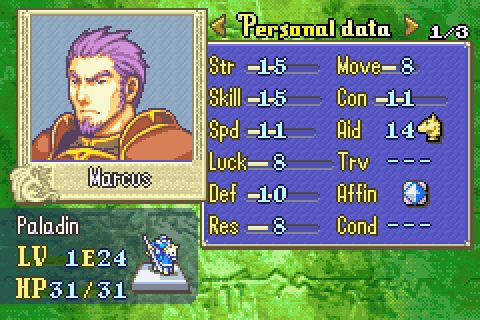
                         If you still don’t understand what I’m trying to do then perhaps a demonstration will help increase your understanding. Let’s use Marcus from Blazing Sword as an example shall we?


                   Now for this example let’s give Marcus’s inventory the following stuff:

  • 1 Hammer
  • 1 Javelin
  • 2 Iron Swords
  • 1 Vulnerary

                    Now under Blazing Sword system the only thing that matters is the weapon that Marcus is currently equipped with. Nothing else in his inventory matters. The only weapon that would slow Marcus down is the Hammer. Marcus has a Constitution of 11 and the Hammer has a weight of 15. Marcus would lose 4 Attack Speed from the Hammer. If Marcus equips a different weapon he does not lose Attack Speed.

                    Now let’s use the Dark Crusade system. What the Dark Crusade system does here is add up everything in the inventory and subtract it from Marcus’s Constitution. I should also point out that the Vulnerary would have a Capacity too so for the sake of this example we’ll assume that it has a Capacity of 2. Alright so let’s add up the combined weight of all weapons together:

15 + 11 + 10 + 10 + 2 = 48

                      (The Hammer weighs 15, the Javelin weighs 11, we used 2 Iron Swords here so under The Dark Crusade’s system both of their capacities double and the Vulnerary has its own capacity)

                      48 - 11 = 37. We then multiply that 37 by 5 (so 37 x 5) which equals 185. Under the Dark Crusade system Marcus now has a stat loss of 185 to Strength, Magic, Skill, Speed, Defense, Luck and Resistance. I’m pretty sure Lyn looks like Frieza to Marcus at this point.

                      Now to be fair, I used Blazing Sword numbers here, which wouldn’t be in The Dark Crusade’s system. So realistically speaking Marcus would easily have over three times that much Constitution, so he’d have a bare minimum of 33 Constitution and if we’re being honest it’ll probably be even higher than that so let’s bump it up to say 40. Also, the weapon weights wouldn’t be the same. I’m most likely going to make Hammers an infantry only weapon (there are quite a few of them that already exist in Dark Crusade) so let’s replace that with a weapon of similar weapon rank, say...the Killer Axe (yep Killer weapons are D rank in the Dark Crusade).

                        Now that we know about how 2 weapons of the same name will double the capacity of both let’s get rid of 1 of those Iron weapons. So here’s what Marcus’s inventory would look like:

  • Killer Axe
  • Iron Javelin (there are multiple Javelins in Dark Crusade. I’m using the E rank version here)
  • Iron Sword
  • Vulnerary

                            Here’s the math: 10 + 9 + 8 + 2 = 29. 

                 
                          I should point out that if we kept the two Iron Swords the Total Item Capacity would have been 53 (Iron Swords in Dark Crusade have 8 Capacity and if both of them are doubled they would have 16 Capacity which would essentially be 32 Capacity). However, I only put the 2 Iron Swords in Marcus’s inventory to prove a point and show the difference between the two systems.

                     If this sounds like too much math to keep track of then do not worry, the game would keep track of all this for you. Ideally there would be a tab down at the bottom of each unit’s menu that would keep track of all this math for the player and if the player were about to step over their Constitution threshold the game would put a Warning Screen up to alert the player.

                       As a final point, I should point out that this game has the greatest weapon diversity out of any game in the series. Each weapon rank has between 5 - 7 different weapons per rank. Most classes can also use multiple weapons so you’ll have tons of options to pick from. The “same name” penalty shouldn’t be a problem. 

Sunday, January 1, 2017

Tearring Saga Chapters 6 - 10

                Here’s another update by yours truly on Tearring Saga.

Pros


  • Narron is a beast! He’s a clear cut example of an Est done right. In fact, he might just end up holding of “Best Est”. I’m really glad I listened to everyone who told me to use him and I’m amazed that the best unit in the game is an Est archetype. Well done Tearring Saga. Well done indeed.

  • Here’s what I think of the map design from about Chapter 5 onward:

  • Chapter 5: I appreciate the little corridors down at the bottom where you had to split your army up in half single file. Unfortunately the downside here is that there’s a pretty big open space after that.

    http://fireemblem.wikia.com/wiki/Beyond_The_Legend


  • Chapters 6 & 7: Wonderfully designed chapters. Your army is split up into smaller groups, both chapters throw enemy reinforcements in places that encourage the player to play faster and the enemy positioning is fairly well done. Before I forget I really liked how the boss in Chapter 6 was designed. He 1 shots your weaker units, 2 shots everyone else and can tank anything that isn’t Runan’s Rapier, magic or Raquel’s Master Bow.
  • Chapter 8: Treasures all over the map. Pirates are positioned in different spots and there are multiple ways to approach this map. It feels like a step down from 6 & 7 but still better than 5. The main problem here is that the enemies are FE 8 levels of scrub (this point will be addressed later in this post)

                       http://fireemblem.wikia.com/wiki/Holy_Dragon_Neuron

  • Chapter 9: Not a fan. It’s mostly an open field with enemy reinforcements that could be easily blocked off. Sure you have some bushes and terrain but for the most part it’s an open field.

                                          http://fireemblem.wikia.com/wiki/Two_Paths

  • Chapter 10: Actually I like this level. You have enemies charging at you from the north while there are recruitable mercenaries from the town that could also swing at you. There’s an interesting event regarding one of your healers that could have some fun long-term consequences. I like stuff like that so this chapter gets kudos from me. There’s also a character recruitment trade-off that seems interesting (although the wording behind said recruitment seems confusing to me, but I think I know what the idea is and I’m a fan). There’s lots to do and terrain is implemented well again.

                                 http://fireemblem.wikia.com/wiki/Freedom_and_Justice


                          Map Design Summation: With the exception of 5 & 9 the map design seems pretty good to me. There’s interesting stuff going on, the terrain is usually well implemented and some of the concepts are at least interesting.


  • Enemy AI: I really like the fact that hurt enemies will retreat in order to get healing. It’s totally preferable to enemies that zombie charge you like the ones in Awakening.

  • Skills: This game has the skill system! Skills are cool! Although I wish that there were some way to click on the skills to see what they could do rather than look them up on serenesforest.net.

  • Holy War Style Talk Alerts: Like Holy War, Tearring Saga will inform you in some way about who needs to talk to who in one of the characters menus. I appreciate little touches like that.


Cons

  • Scrubby enemies: I have to say I’m a little disappointed at how easy these enemies are to kill. Most enemies will easily have below 0 Attack Speed which doesn’t make it all that difficult to kill them. The zombie chapter is incredibly easy. Here’s a picture I took of the average zombie in that level:


                              Yeah, zeroes all across the board. That’s pretty lame. Unfortunately the enemy reinforcements are positioned in such a way as to encourage grinding. In fact, that’s exactly what I did: I got my Pegasus Knight and Sasha 3 whole levels from this chapter while also providing additional level-ups for guys like Narron and Zieg. Unfortunately most enemies in other levels aren’t that much stronger either.

  • Clunky World Map: Also not a fan of the clunky world map so far. You’re only ever given one route to go and it’s pretty obviously where you need to go. Maybe I’m just being impatient and need to wait until later on.

  • The Arena System: This game has an abusable GBA styled arena system.


                        Overall: I’m still enjoying this game. There’s plenty of nice little touches that make it all the more enjoyable. It’s not perfect (no Fire Emblem game is) but the positives definitely outweigh the negatives.

Rough Draft Dark Crusade Battle Formula

Weapon Triangle
  • Physical Weapon Triangle: Swords & Hidden Weapons > Axes & Bows > Lances & Chain Weapons > Swords & Hidden Weapons

  • Magical Weapon Triangle: Anima > Light > Dark > Anima

Weapon Triangle Bonuses
  • Swords & Hidden Weapon Bonuses Over Axes & Bows: + 20 Crit. (- 20 Crit Evade for Axe and Bow Users at WTD)

  • Axes & Bow Bonuses Over Lances & Chain Weapons: + 30 Avoid (- 30 Avoid for Lances & Chain Weapons)

  • Lance & Chain Weapon Bonuses Over Swords & Hidden Weapons: + 6 Defense (- 6 Defense for Swords & Hidden Weapons)

  • Anima Magic Weapon Triangle Advantage: + 20 Crit ( - 20 Crit Evade for Light Magic)

  • Light Magic Weapon Triangle Advantage: + 30 Avoid ( - 30 Avoid for Dark Magic)

  • Dark Magic Weapon Triangle Advantage: + 6 Resistance ( - 6 Resistance for Anima Magic)

  • Miscellaneous Bonus: Bonuses that come from Supports, Terrain, Skills, the Weapon Triangle, Leadership Stars, etc.


Double Attack
Attack Speed: Speed - (Total Item Capacity - Constitution, 0 if negative)

Double Attack if: (Attack Speed – Enemy’s Skill) >= 4

  • If a unit double attacks another unit the second strike will deal half the damage of the first strike unless the double attacking unit is a myrmidon or a ninja.

Damage
  • Physical Damage: Strength + (Weapon Might x Effective Coefficient) + Weapon Rank Differential +  [ (Attacker Constitution - Defender Constitution) / 2 ] + Miscellaneous Bonus(es)

  • Magical Damage: Magic + (Weapon Might x Effective Coefficient) + Weapon Rank Differential +  [ (Attacker Constitution - Defender Constitution) / 2 ] + Miscellaneous Bonus(es)

                        Weapon Rank Differential: The difference between the weapon ranks of the weapons being used by the two enemies x 3. For example: If a character with a D rank weapon attacks a character with an E rank weapon the character with the D rank weapon gains 3 extra attack with the character with an E rank weapon lost 3 extra damage. Here are the Dark Crusade Weapon Ranks:

  • G
  • F
  • E
  • D
  • C
  • B
  • A
  • S
  • SS
  • *

  • Prf rank weapons nullify the weapon rank differential.

Effective Damage Against Mounted Units & Fliers: x 3

Effective Damage Against Unarmored Infantry Units, Dragons, Dragon Frost’s Effective Damage Against Itself: x 2

Effective Damage Against Armored Infantry Units: x 1.5

Physical Defense: Defense + [ (Attacker Constitution - Defender Constitution) / 2 ] + Miscellaneous Bonuses

Magical Defense: Resistance +  [ (Attacker Constitution - Defender Constitution) / 2 ] + Miscellaneous Bonuses

Accuracy:
(Weapon Hit) + (Skill) + (Luck) + Miscellaneous Bonus(es)

Avoid:
(Speed / 2) + (Luck x 2) + Miscellaneous Bonus(es)

Battle Accuracy: Accuracy - Enemy’s Avoid [lowest value is 0, highest value is 100]


Critical Hit Rate:
Weapon Crit + (Skill / 2) + Critical Bonus + Miscellaneous Bonus(es)

Any class that can only use one weapon gets a critical bonus. Here’s a list of the classes that get critical bonuses (I’m still working on the names for some of them):


  • Myrmidon - Swordmaster - Trueblade
  • Ninja - Great Ninja - Elite Ninja
  • Soldier - Halberdier - Sentinel

  • Villager - Sly Mercenary - Rogue Leader (the Chain Weapon only class tree)

  • Fighter - Pirate Captain - Pirate Warlord
  • Archer - Sniper - Marksman
                     

1st Tier Crit Bonus = 15 %
2nd Tier Crit Bonus = 25 %
3rd Tier Crit Bonus = 35 %

Crit Evade: Luck + Miscellaneous Bonuses

Battle Crit Rate: Critical Rate - Enemy Crit Evade