Thursday, February 15, 2024

The Top 10 Most Busted Mechanics in Fire Emblem: # 8, # 7, & # 6


 # 8 - Bonus Experience (Path of Radiance)

The next entry on the list of busted mechanics is bonus experience from Fire Emblem: Path of Radiance. Some of you might have read that statement and might be thinking "but bonus experience is in other games besides Path of Radiance. Why is this game being singled out?" We'll get to that.

Bonus Experience is one of those mechanics that sounds like a good safety net idea. Is there a unit who's falling behind? Give them some free experience so that they can catch up with your strongest units. It's a great idea in theory, but there's a problem: That experience can be freely given to anyone, including your best units. 


And this is why the mechanic is on this list: Your best units can be given even MORE experience so that the gap between your strongest and weakest units furthers even more. Here's one tip that the Fire Emblem wiki page for Bonus Experience mentions:

"You can first use Bonus EXP once you reach Chapter 8. You can use a little on Ike and Oscar, Kieran, or even Boyd at that time, but your best bet is to save it for two chapters and immediately pour as much as possible into Marcia. As a flier, she can make good use of it to instantly become a stronger, more mobile version of Titania."

Source: https://fireemblem.fandom.com/wiki/Bonus_Experience

I actually did this during my last playthrough of Path of Radiance. I dumped all my Bonus Experience onto Marcia as soon as I got her, and she mercilessly annihilated the game. This is why Marcia's considered the best unit in the game: She's the best candidate for a bonus experience dump, which is all she needs to destroy the game. 

Remember the # 10 entry, Paragon and Veteran? Two skills that let units rapidly accumulate experience? Bonus Experience takes the most broken aspects of those skills, and dials it up to 11. Characters like Marcia and Oscar can instantly promote and be used as a means to obliterate the game. What separates Path of Radiance from Radiant Dawn is that even on Hard Mode (can't speak for Maniac Mode) you're given a BUNCH of Bonus Experience, which allows for things like this to happen.


# 7 - Reclassing


I'm curious to see what everyone's reactions will be to this. Some people might agree while others disagree. The point of reclassing is that any character in the player's army can be whoever the player wants them to be. Ultimate customizability! Who could say no to that? 

The issue with reclassing is that it becomes very difficult to design the game because the game developers have no idea what the players will have access to at any given moment. How could they? There's a near infinite number of possibilities for any character to be at a given time!

 Another major problem is that reclassing can easily make a character really strong with virtually no effort. 


 Three Houses is probably the biggest offender here where everyone in the game can turn into a powerful Wyvern Lord, and gain the strongest Battalion abilities, gambits, and skills. As a result, it makes the game that much easier to break. 

 Wolf and Sedgar easily become really powerful when reclassed into Generals in Shadow Dragon, Jakob in Conquest can be reclassed into a Paladin, Elise can become a Wyvern, which in turn create new ways for the player to break the game. 

To recap, reclassing is a mechanic that makes balancing and designing the game that much more challenging AND it makes it too easy to make a powerful unit.


# 6 - Stride


Speaking of Three Houses and "broken", the Stride gambit makes its debut here at number 6. Stride is a gambit that gives up to 12 different units + 5 Movement. + 5 MOVEMENT?! ARE YOU KIDDING ME? As plenty of people will tell you, movement is the best stat in Fire Emblem. Being able to get from Point A to Point B faster is always a good thing, and any tool that enables that will automatically be really valuable.

Increasing movement by one is already very good. + 2 Movement is really good. + 5 is stupid. It makes it super easy to get from Point A to Point B. To make matters worse, Stride is given at an E rank authority in Three Houses! E RANK! Anyone can have Stride from a super early point in the game, and then it'll be there for you the entire time. 

The fact that this can boost the movement of up to twelve different characters also allows for even crazier shenanigans to happen. Combine that with a game where anyone can be a flier, and you get a game that's bound to get broken by a savvy player.


There's no drawback toward using it, and Stride is a big reason why Three Houses chapters can be cleared so easily once you know how to use them. Whoever thought that being able to boost the Movement of multiple units by 5 was a good idea should not be designing Fire Emblem games.

Tuesday, February 13, 2024

Top 10 Most Busted Mechanics in Fire Emblem: # 10 & # 9


# 10: Paragon and Veteran

Kickstarting the list would be two skills that it make it easy for a unit to rapidly accumulate experience: Paragon and Veteran. The reason why they're on this list is this: Rapidly accumulating experience lets certain units gain level-ups, and by extension gain stats, in a quick period of time. Robin is considered so insanely powerful in Awakening because of this skill. Just Pair Up Robin with a powerful partner, and this skill will allow them to rapidly accumulate experience to the point where they break the game in half with it. If we're being technical, there are other reasons why but Veteran is typically a huge reason why Robin snowballs so fast, and why Awakening is considered an easy game to break.


Paragon's less notorious, but operates under a similar line of logic: Doubling experience means that a certain unit can snowball until their stats are so high that they can easily obliterate enemies. It's a great idea for characters that start under-leveled so that they can catch up, but outside of that these skills are a recipe for easy juggernaut creation.


# 9: "Powerful Weapons": Forging / Holy War Weapon Kill Crits / "The Nosferatu Effect"


When asking people's opinions about busted mechanics, I saw different opinions about mechanics that can ultimately be described as "really busted weapons". Since I think all three of these should be included, I decided to group them all together. This will not be the only entry on the list where multiple mechanics will be grouped together. Started off the "busted weapons" list is forging. 

Since there are multiple different varieties of the forging mechanic, I thought I'd specify as essentially two different kinds:

  • DS Forging 
  • Japanese Path of Radiance forging.

DS Forging

Why is Caeda so powerful in Shadow Dragon? Easy: Her forged Wing Spear lets her kill a huge number of enemies in a single hit. How is that possible? Forging. What makes the DS Fire Emblem games version of forging so powerful is that you can take weapons that are already powerful, and make them even stronger. 

Weapons that deal effective damage and Brave Weapons can get a huge buff in damage and in critical hit rates which makes for some stupidly powerful weapons, and some silly results. Awakening took this to a whole new level when 

This isn't to say that there aren't other imbalanced versions of forging too. Case and point...

Japanese Path of Radiance forging.


The main reason why Japanese Path of Radiance forging is on here is for one simple reason:
The Japanese version has an unusual error where, if a weapon with five base crit (Slim Sword, Slim Lance, or Thunder) is forged to have 0 crit, the value wraps around and gives the weapon 255 crit, effectively giving its user a perfect critical hit chance in battle. All localizations of Path of Radiance correct this error. 


So while I doubt very many people have experienced this, I do think it's worth mentioning that a weapon that allows perfect critical hit rates in a game with notoriously weak enemies (although Path of Radiance Maniac Mode actually has enemies that are bulkier than usual) sounds like a recipe for hilariously busted shenanigans. 


Since I'm on the topic of forging, I would like to say something about other forging systems. As one poster in fire emblem reddit brought up: 
     "Fates' idea of requiring multiple copies of weapons is nice on paper but leads to cheaper items becoming a bit too dominant as they can be forged up to the same Mt as higher tier equivalents (up to a certain extent) while also having more hit, no penalties and, in the case of bronzes, a useful +10 dodge bonus. On top of that, the way forging materials are tied to the my castle stuff requires you to waste time on online features or just save edit 99 of them into the game and call it a day, which is what most people who invest a lot of time into Fates end up doing."


I would also like to argue that on principle, I don't like how Fates, Echoes, and Engage don't have weapon durability but still have forges. It makes forging that much better, and provides no downsides to using forges. So it turns into a game of "find your best weapon and spam it". It reinforces the idea that weapon durability is a great mechanic.

The only forging mechanic I can think of that's actually balanced comes from Berwick Saga:


But that's a different topic for a different day. Moral of the story: Forging is broken.

Holy War Weapon Kill Bonus


So in Fire Emblem 4 there's a mechanic where a weapon's kills are stored and counted by the game. Once a weapon gets over 50 kills, it gets the ability to land a critical hit. "For every kill that the weapon makes afterward, its chances of landing a critical hit improve. The bonus caps out on 100 kills or 50% bonus." (Source: https://fireemblem.fandom.com/wiki/Weapon_Kill_bonus) 

Scylla actually did a great job breaking down why this mechanic is super busted: 
        "There is no way to get crit avoid in FE4, and because of the way crits work in FE4 where the damage is doubled but enemy defense is only applied once, FE4 crits start to deal more damage than average crits when enemy defense gets high which is what you'll start encountering in gen 2. As a result Brave weapons with 100 kills have crit rates in about the ~77% area and will out damage Holy weapons while being far cheaper."

Keep in mind, Holy Weapons have 30 might and give stat boosts as outrageous as + 10 or + 20! The fact that those super busted weapons aren't considered the most powerful in the game goes to show how ludicrous the Weapon Kills mechanic is!


"The Nosferatu Effect"

Last, but not least, we have "the Nosferatu effect". This is basically  any weapon that allows you to recover HP based off of the damage that you deal. This makes enemy phase tanking pretty easy, since Nosferatu makes the ability to survive really easy.   

I can potentially see someone mentioning how the Nosferatu tome was weak in this or that Fire Emblem game, which is true, but I think there's a catch to discussing Nosferatu and how powerful it is:

1) Either the weapon has to be bad so that Nosferatu doesn't break the game 

OR 

2) Nosferatu becomes the best weapon in the game, or among the best weapons in the game.


The fact that this "viability binary" comes across so much proves that giving the player access to healing HP while dealing damage should be a cause for concern.

Monday, March 6, 2023

Ranking First Maps Part 4


Below Average Tier (Continued)

Fates: Revelation


Next on the list is Revelation. The easiest way to summarize this map is that it's a Corrin steamroll. It's a map where you have to kill two bosses before Chapter 5. On paper this sounds like a net positive. In practice...well, I'll just quote what somebody else had to say:

"RV: On normal and hard? Easy, just throw Corrin at the enemies as they run toward you. On Lunatic? Fuck this map, never play Revelation Lunatic. You have 5 turns to kill the Nohr mooks, and some genius decided to take away their Wyverns. Usually a lack of Wyverns is a good thing, but this time it means they can't cross the river, and you have to cross the river 1 square at a time yourself. Whoever though this was a good idea should be fed to Lilith.""

"Fuck Revelation's version of this map. Particularly the Lunatic one. Like somebody else has said, you've basically gotta cross the river to bait the cavalier to win. Which is some shit because to do this you have to realize that it's a thing you can do. I mean, I thought of it because of Awakening's water trick, and memories of having Hector ferry mounted units across rivers. But it's such a stupid and obscure thing to actually require from the player at any point in the game - let alone 6 chapters in, without telling or even hinting at the player's ability to Jesus their way across a body of water. For that reason alone Chapter 6 is probably the hardest map in Lunatic Revelation, for all the wrong reasons"

Source for both quotes: https://www.reddit.com/r/fireemblem/comments/65995c/fates_map_discussion_thread_48_chapter_6_all/


Birthright

Are you kidding me? A boss kill map where the boss killer is literally right next to the boss? I get that Birthright is meant to be for beginners, but did the designers just assume that people who are new to the series are idiots? The only reason why it's not listed in the "garbage" tier is because you're given plenty of units to use, and you can choose to give other units experience. 


Garbage Tier

As far as I'm concerned, these first chapters have no redeeming qualities. There's an awful lot of them.


Gaiden


Yep. This is the first map of the OG Gaiden. It's a pretty solid indicator of what's to come: An empty field with terrain haphazardly strewn about, and enemies in a random formation. To the game's credit, you at least get to start out with 5 units (Faye doesn't exist in Gaiden). There's very little in the way of strategy here. Maybe getting Tobin and Cliff to promotion level in preparation for the shrine? 


Why the other first maps on this list are considered garbage

For the sake of saving time, I figure that since the first maps of these games suffer from the same issues, I can just summarize why they all suck:

  • Sacred Stones 
  • Echoes
  • FE 12 
  • Awakening & Engage: (They basically have the same first chapter)
  •  Path of Radiance
  •  The prologue of Fates (yep. The first map of the Fates prologue is in this tier) 

1) 2 playable characters or less: All of these first chapters give you two playable characters or less. Technically, Echoes gives you a lot more than just two, but let's not kid ourselves: This map is a Mycen solo. It may as well be a 1 unit map. 

As a result of having so few characters, there are very few strategies and ways to replay these maps. That leads to a duller experience all around. 


2) Really short map with nothing else going on: All of these maps are really short, and having nothing else to them. I guess Sacred Stones has terrain, but it's a dull implementation of its terrain that just makes it easier for Seth to chokepoint the map. Once again, this hurts replayability. 

I get that a designer would want to make their first map simple, but you can have a first chapter that's simple without insulting the player's intelligence, and that's what these first chapters do.

_____________________________________________________________________________

The Multi-Rate Tier

There are two games whose first chapter can be different based on the player's choice. Blazing Sword and Shadow Dragon. Since they rate so differently, they needed their own tier:


Blazing Sword - Lyn Mode: Garbage


There's only one playable character and two enemies. There's nothing else to this map. Textbook example of a map that treats the player like an idiot.


Hector Mode: Meh


You know, this is almost a good map. The biggest problem is that there's only two playable characters here, and only one of them (Hector) is going to be doing any fighting. What's cool about this map is that there are two different methods of approach, and Matthew's thief utility comes in handy here. The lack of a healer makes the map marginally more challenging. Still, it's not bad.


Eliwood Mode: Meh


For a first map, there's nothing super wrong with it, but it's also not super great either. I might rate it higher if that village were actually threatened. Still, 6 playable characters has to count for something. Not much else to say about the map.


Shadow Dragon: Prologue - Garbage


So this map is basically a Marth solo with nothing else that's interesting about it. Joy.


Shadow Dragon Chapter 1


The first chapter of Shadow Dragon gets the same rating as FE 1's first map (Meh) unless we're talking about H5. Based on what I've been told, H5 is significantly harder. I've also been told that the boss has to break his weapon before you can move on. That sounds like terrible design to me. If it's not H5, then I'm assuming that it plays pretty similarly to FE 1's first map, right? So it ranges from Meh to Garbage.

Ranking the First Maps Part 3


Meh

First chapters that are ranked in the "Meh" tier are chapters that aren't bad per se, but they're not particularly good either. Another important criteria of the "Meh" tier is that with a couple of tweaks, these could be good maps.

Fire Emblem 1

And here is the first map of the entire franchise and.....it's meh. To the map's credit, you do get a total of 8 characters (this includes Wrys in the village) so it at least checks one box off. I think the thief down below is supposed to threaten the village up top? If that's the case, then this doesn't work. Just like with Mystery of the Emblem, the thief is closer to the player than the village. It's pretty easy to kill the thief before it has a chance to destroy the village. 

This map lets you buy weapons, which is pretty rare for a first map. The fact that you have to recruit your healer after beating most of the map is an interesting twist. Forts and forests make life easier for the player, and the map layout is simple enough. 

Overall, not a bad first chapter, especially since this is the first time a Japanese player would have been exposed to the franchise as a whole. With a couple of tweaks, it could have been better.

Conquest


As a quick heads-up: Fates is one of those games where the player has different choices on how to begin. So, I'm going to rate the first map of each route, and then I'll rate the first chapter of the prologue. 

Conquest's first chapter is the best first chapter of Fates and it leaves room to be desired. The only interesting elements of this map are: 

1) Choosing whether to kill Ryoma or Sakura 

AND 

2) Baiting the Takumi / Hinoka pair up.


Outside of those two choices, there's really not much else to say. There are very few enemies to fight, which hurts the replayability of the map, and there are no turtle disincentives. Ryoma's avoid is really high, so fighting him feels like an even bigger RNG gamble than is usual for Fire Emblem. That counts as a negative.

 To the map's credit, you at least get 6 characters, so it checks one box. Another positive is that Elise has a Freeze staff, which can be helpful here. There's also the Dragon Vein, which makes the map a little more playable, since you can have more characters attack Ryoma. Considering how powerful he is, this isn't recommended but at least the option exists. And another positive is that poor unit positioning can cause a restart. 

Overall, this map is not terrible, but there also aren't too many positives to say here either.

Tearring Saga

What I find interesting about Tearring Saga's first chapter is that you spend the first four chapters buying stuff with Runan and his crew. Once again, it's pretty rare for the first chapter to give the player the option to buy things. Points for creativity. Afterward, the drawbridge goes down, and Runan's crew have to take on the enemies. Meanwhile, Sasha and Kate have to flee the bad guys.

One big negative is that Runan's crew are forced to sit behind the drawbridge, so there's nothing you can do about Sasha and Kate. It feels like the map takes longer than it needs to because of that. Another negative is that the terrain layout is really dull. The actual combat takes place on an open field with a little bit of forests if you need an evasion boost. 

Unlike the maps ranked below it, it feels like a couple of tweaks could have made it good. The maps in the "Below Average" tier are just mostly really bad.


Below Average Tier
These first maps are straight up bad. They might have one quality that prevents them from being outright terrible, but they're still a net negative overall.

Three Houses

The only nice thing I can say about this map is that it has 4 playable characters. So it checks off one box. Unfortunately, this is mitigated by the fact that Dimitri, Edelgard, and Byleth play too similarly to each other. They're basically just sturdy(ish) melee fighters. Claude's the only playable character on this map who fights differently than the others. In practice, it almost feels like you've got 2 different characters, as opposed to four.

Another major negative is that generic enemies double attack your characters on Maddening mode, which is terrible design. It practically incentivizes the player to play slower (as opposed to faster) and to take their time fighting one enemy at a time. Incentivizing slow play is always a net negative. 

Bytheway, the reason why Three Houses is only having this map rated is because no matter which route you play, this will always be your first chapter. That separates it from Fates, FE 7, or Shadow Dragon. So this will be the only Three Houses map on this list, and it's a pretty poor showing.


Radiant Dawn


Unlike Three Houses, Radiant Dawn's first map only gives you three playable characters to start with. Two of them are squishy ranged fighters, and the other one is Edward. The basic premise of this map is to have Edward take the hits while Micaiah and Leonardo provide chip damage from a safe distance. The terrain makes distance combat fun, since Micaiah and Leo have fun walls to attack behind. 

There is one negative that is unique to Hard Mode: No Weapon Triangle. This map feels like it was designed with the weapon triangle in mind. It really benefits Edward. Take that away, and suddenly his chances of blocking axes with his face improves. That's a big negative, which really hurts the ranking of this map. Another negative is no turtle disincentives. 

I want to like this map more, but I can't because there's not enough going for it to merit a higher rank. 

Ranking the First Maps (Part 2)

Really Good

This tier is reserved for first maps that get lots of things right. The reason why these maps are a whole tier below the top tier is because their turtle disincentives aren't as strong.


Binding Blade


The first map of Binding Blade gives the player 6 characters to use, and there's a brigand that pops up next to the village with the intent to destroy it. It's a weak turtle disincentive, but it still exists so it counts. So it checks both boxes as far as first maps go.

On Hard mode, most of the cast will do menial damage while Marcus carries the team. I am going to deduct points for that, since it's more ideal to have multiple viable characters during the first map. To the game's credit, at least enemy strength is more balanced than in some of the games that have come after.


Thracia 776


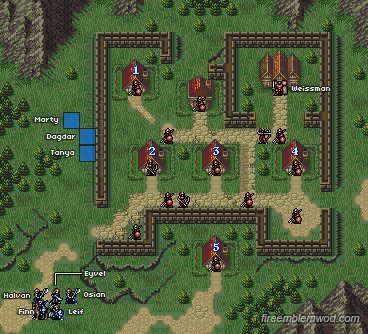
Next on the list is Thracia 776. Here, you get a total of 8 characters to use, two houses you can visit that will result in obtaining the Pugi Axe and a Brave Axe, and multiple enemies to fight. Weissman is more difficult than the typical first chapter boss, and while the enemies aren't that difficult to beat, they're still better than the normal axe wielding brigand that frequently show up in a first chapter. 

The map gets points for having side objectives, but also loses points for no turtle disincentive. This doesn't hurt the map as much since most first chapters typically don't have them, but it is worth noting.

 It's really cool how the game gives you such powerful weapons and characters right off the bat: Eyvel kicks ass in this part of the game, Dagdar's really strong, Finn is super useful (and joins with a Brave Lance. How many games just let you have a Brave Lance from the first chapter?), and you get Orsin with the Pugi. 

It's a strong start to an excellently designed game.


Mystery of the Emblem 


For a first chapter, Mystery of the Emblem sure knows how to start on the right foot. If you count Mallicia, you start this map with 9 characters. Thieves will appear from the cave to the left and will attempt to destroy the village. On the one hand, this is a turtle disincentive so kudos to the map for that. On the other hand, the thieves are closer to the player than they are to the village, so there's no reason to rush toward the village. It gets some points for the attempt at a turtle disincentive, but then it loses points for how weak it is.

The mountain pass where the brigands are can be a little tedious to get through too. I went back and checked my notes  on this map and I said there that only Marth and Arran can move here. That's another net negative for tedious terrain. Still, it's a pretty good map to start a game on.


Above Average: Holy War


Holy War's first map is kind of weird to rate in this particular context. On the one hand, it checks both the boxes off. By the end of the map you wind up with ten different characters in your army:

  • Sigurd
  • Alec
  • Noish
  • Arden
  • Quan
  • Ethlyn
  • Finn
  • Lex
  • Azel
  • Midir

But you don't get them all at once. You just start out with Sigurd, your Christmas Cavs, and Arden. Your Lenster squad shows up later and has to play catch up after Sigurd, Alec, and Noish have already started moving. Lex and Azel also show up way the heck out there on the map, away from your main army. So, Holy War's prologue is kind of weird in this respect. Credit given to where credit's due, you still get a bunch of units to use on the first map, and that's always a positive.


As for turtle disincentives, this map introduces the concept that villages don't automatically get destroyed, but instead burn over time. Considering the fact that you lose 500 gold per burn, this works to incentivize the player to move fast. 

However, some brigands are so close to the villages that you'll still lose some money even if you go fast. This is something that could have been handled better, but at least some form of turtle disincentives exist. The village by Jungby gives you a Speed Ring, which is really important, so you'll definitely want to save that asap.

Arvis also gives you a Silver Sword, which helps to teach the player that conversations can net the player free stuff. 

Two negatives worth mentioning are that Sigurd can obliterate enemies by himself, which puts some pressure off of the player in addition to the Evans army being easy to dismantle by simply blocking the bridge.

On the one hand, Holy War meets both criteria for a first map. On the other hand, it does so in funky ways that hurt the rating. Even with its negatives taken into account, Holy War's first chapter is still leagues better than the maps ranked below it. It fits both criteria, and it manages to teach the player a great deal about the game's mechanics. This is why it merits its own unique rating. It's much more interesting to play than the map where you have few characters in a small map, but it's also not quite as good as the maps ranked above it, hence it's own tier titled "Above Average". 

Ranking the First Maps of Fire Emblem

Ranking the final chapters of each Fire Emblem game was fun. This naturally made me want to rank the first chapters of each map. I added the Kaga Sagas to this list because I've at least played the first chapter of each Kaga Saga, even if I haven't beaten Tearring Saga or Vestaria Saga yet. First, we need to establish the criteria for what makes a well designed first chapter:

1) Does the first chapter have more than 3 characters?  The reason why this is a metric is because there's a difference in quality between maps where you can play 3 characters or fewer versus maps where you have 6 - 7. More characters usually means more strategies, and thus more ways to play the game. That's good. It also makes the map more interesting.

2) Bonus points for turtle disincentives or side objectives: I tend to be easier on the first chapter, because I don't expect it to happen, but there are first chapters that do this and they deserve to be rewarded for it.


Gold Standard: Berwick and Vestaria Saga
These are the two games that come to mind that do pretty much everything right when it comes to the first map. I've already done a map design review for the first chapter of Berwick Saga: https://thecrusadergrant.blogspot.com/2022/03/berwick-saga-map-design-review-part-1.html

Tl;dr - "So, to recap. On the first freaking map of the game we have:
  • Multiple bosses.
  • Good map layout with 2 avenues of approach.
  • 1 timed side objective where the player has to protect their healer on the opposite side of the map.
  • 1 side objective where enemies drop gold. If the player doesn't get to these enemies in time, they permanently leave the map.
Yeah, this map is a case study on how to start your game. It does everything right. It also gives you 9 characters to start out with. Each character has their own nuances of how to use, which really increases the strategy in this chapter. Brilliantly done!

Vestaria Saga


Vestaria Saga is a map that I never thought would be ranked this high, and yet its first map does everything correctly. You get 6 characters right off the bat, a turtle disincentive in the form of an extra defeat condition: If the ships' HP drops to 0, you lose, and you also have a thief threatening to destroy a house. It's pretty rare for the first map to have all these things. 

You get 5 units, so it meets that requirement. The houses in between the player and the ship can be visited, which can net them money and funny NPC dialogue. It can also run the risk of slowing the player down since that could be time used to get to the ship faster. 

The village to the side will also be threatened by an enemy. This is both a turtle disincentive, and it counts as a side objective since it's out of the way. Overall, it's a great map that pretty much does everything one could want from a first chapter.

Saturday, February 4, 2023

More First Impressions of Engage (Up to Chapter 15)


The Map Design

  • So, I LOVE Chapters 10 and 11 from both a gameplay and a storytelling perspective! Getting your current Emblems taken from you, and then having enemies use them against you, feels like the kind of thing Thracia 776 would do. It reminds me a lot of the Manster Arc in all the best ways. 

  • Chapter 11 is currently my favorite map! I love the fact that it's "a seize map disguised as an escape map" to borrow Scylla's words. This map does the best job of putting pressure on the player by providing turtle disincentives. I hope more chapters in Engage do that.

  • Chapter 12 is a desert map that I don't hate. That's refreshing. Quicksand is annoying, but at least it can be played around. The only issue I have is that it's a rout map with reinforcements. Why does IS give reinforcements to rout maps? 

  • Chapter 13 is a solid fog of war map. The destructible parts of the map provide options as to where the player should / shouldn't go. They also provide a level of choice as to which enemies the player can deal at a given moment. 

  • Chapter 14 is excellently designed! It has multiple paths to approach the boss, treasure chests that get threatened by thieves, and turtle disincentives in the form of enemy reinforcements that show up behind the player, a status staff that breaks you, OH and a flying boss with a dancer ability! That's pretty cool!

Map Design Wrap-Up: It feels like the map design has dramatically improved ever since Chapter 10! It's really exciting to see this game provide interesting challenges and scenarios for the player. I haven't finished Chapter 15, but I like I've seen so far. If the game maintains this level of quality, it will definitely reach "Top 5 Best Map Design" for me.


The Unit Balance
  • This game has some really strange unit balance, which is why I reached out and asked people what their thoughts were on it. I agree with Scylla that there aren't any Haars / Camilla type characters. Nobody strikes me as "this is the uber unit that will destroy everything". I'm not used to that. Perhaps over time we'll all find out who the best units are. It's really strange not having an obvious juggernaut.

  • Alear is probably the most underpowered "My Unit" I've come across. I'll take it! In addition to the damage that My Units deal to the game's narrative, they're also usually OP. Kris, Robin, and Corrin (at least on Revelation). Byleth was really good, but a step in the right direction. Alear is even less powerful, and I really like that. Alear's good, but not game-breakingly good. 

  • As of right now, the best characters in my army are a mix of Kagetsu, Merrin, Timerra, Alear, Alcryst, Louis, and Ivy. Forged a Wo Dao for Kagetsu to have even more crit so he can land some sweet kills. Ivy is fun to use, but she still gets critted or double attacked, a lot. Is she supposed to have the Lyn Emblem?

  • Merrin's really good! Double attacks everything and can one round KO a lot. Wolf Knight enemies also double quite a bit. Is this class supposed to be strong?

  •  Timerra and Louis's tanking abilities are much appreciated. Great Aether is fun. There are plenty of fliers for Alcryst to snipe, and the occasional Luna proc is also fun. Lucina's Emblem is fun to use on Alear. I really like the way this game handles Chain Attacks. It's neat to set them up in order to dish out extra damage. 

  • Diamant was promoted to Successor, and he's coming across as decent, but not an uber unit. He started off so much better, and hasn't scaled super well. Is there a better class to promote him to than Successor? If so, which is it?

Unit Balance Wrap-Up: This game's unit balance is strange. In a sense, it's almost the reverse Fire Emblem 12. Fire Emblem 12 was a game where all your earlygame units were the best, and the later units were lame. In this game, being an early game unit is no guarantee of success. Being a mid / later game prepromote is better. It's an interesting take on unit balance. Not sure how I feel about that.


Other Gameplay Thoughts

  • Hard Mode so far hits the sweet spot for me in terms of difficulty and challenge. It's tough enough to require me to think and turn my brain on without being stupidly difficult. This game does a good job of punishing a player's mistakes, which makes me respect it all the more. 

  • When it comes to gold, I feel like I have plenty for what I want to do. I usually buy up Master Seals and Second Seals whenever they're available. Every now and then, I'll buy a weapon or two, but I always feel like the weapons that I have are sufficient. The game doesn't strike me as too generous with its resources, but it's also not super restricting. Resource management is turning out to be a net positive for this game.

  • Weirdly enough, I don't miss weapon durability here. This game seems to balance around that just fine.

  • Scylla was right about the resurrection stones: They're a net positive. It makes the game more difficult to juggernaut when you have to kill the same boss more than once. Hortensia needing to get killed three times made me feel like I had to bring my whole army with me just to kill her. Definitely changed my mind on this.


Summary: This game is definitely earning its reputation for stellar gameplay. It gets a lot right, and it's making for a fun experience! The dialogue, supports, and the story aren't very good. However, I think this game works as "gameplay, the game". I can see this fitting in A tier along with FE 3, 12 & 6.