Friday, December 23, 2016

A Further Look Into Conquest's Gameplay Part 2

                                     If you’re feeling bored while reading this feel free to start a drinking game and here is the rule: Take a shot whenever you read something along the lines of “I like the idea but the execution is off” or some kind of variation of that. It’ll come up a lot and for good reason. Okay, let’s get started then.

                       Skills: Conquest has a great skill system. I would argue that the Fates skill system is the best in the series. Why? Well for starters Conquest gives enemies skills and not only that, but also powerful / threatening skills. Why is this important? Well one of the problems in previous games that implemented the skill system is that the player’s units always got really good skills while enemies generally speaking wouldn’t get any, or if they did their skills would be pretty weak by comparison. For all the problems that Awakening had they at least tried to give generic enemies powerful skills. Granted, Awakening went overboard in Lunatic + but it still felt like a step in the right direction to me. Then along comes Conquest and suddenly the skills are fair again (well most of them. I’ll cover the ones that aren’t fair or just aren’t good in a minute) but still threatening. I also LOVE some of the new skills that Fates introduced or tweaked. Here are a few examples:

  • Wary Fighter:  This should be the default skill for Armor Knights. Being able to prevent enemies from double attacking is a FANTASTIC idea that goes a long way toward reducing an enemy’s damage output. Slow, tanky enemies with Wary Fighter are harder to deal with because you can’t just stomp them into the ground by double attacking them. Moreover, this is a fair skill too because it doesn’t screw the player over either. This skill should definitely stay.

  • Live To Serve: Again, I’m a really big fan of the idea of the healer being able to heal themselves. It always seemed tedious to heal a healer that took damage so this skill is right up my ally. I would like to see this become the default skill for healer classes.

  • Counter: I never really liked the Awakening version of Counter. It more or less punished the player for counter attacking which there was nothing you could really do about it outside of attack them first from a distance or hope you killed the enemies first. Fates ended up fixing Counter so that it only worked when the player initiates an attack and only when the player initiates an attack up close. There are so many different ways to deal with the Fates version of Counter, but the skill is still powerful enough to force the player to pay attention which is what Counter is designed to do. Fates made Counter fair and I’m okay with this version of Counter sticking around.


  • Personal Skills: This is another fantastic idea that Fates introduced that I think should also become a staple of the series. Personal skills give each individual unit their own unique flavor and normally they can be taken advantage of tactically. While there are some that seem situational (IE Selena’s personal skill) they do at least cause the player to sit back and think which I consider a good thing. Future games should work on personal skills that are more consistent and tactical, but at least it’s a really good step in the right direction.


The Negatives
                          I wish I could say that all the skills in Fates were awesome but unfortunately that is not the case. While most skills do a fantastic job at adding to the gameplay there are some skills that detract from the experience.

  • Staff Savant: Staff Savant is one of those skills. The main problem with Staff Savant is that it gives enemies unlimited uses of certain staves that really should not have unlimited uses. Have you ever dealt with an enemy that had access to unlimited Freeze staves? That crap is annoying and tedious. How about infinite uses of Entrap? Or even worse….infinite uses of the Hexing Rod? Yeah this does not lend itself to good gameplay. It makes powerful staves too powerful and eliminates the balance put on them.

  • Lunge, Entrap, Pass:  So why did I put these two skills and one staff here together? Well they all have something in common: They screw over player unit positioning which is bad for the game. Lunge helps the enemy out far more than it does the player since it’s most effective when large groups of units with this skill use it. Furthermore the only real solution to Lunge is either killing them first before they get a chance to use the skill or killing the Lunge user on the counterattack. In order to achieve either result in an optimal manner you have to boost your stats. In other words, Lunge promotes stats over positioning and that’s not a good thing. 


                           The Entrap staff is even worse since it can be used at a distance with no consequences of the user should the Entrap staff miss. Once again the optimal solutions here are either:

  1. Boost your stats so that you can take a hit from the enemy hoard and kill them (For example in Chapter 26 I let my paired up Xander get in range of an Entrap maid because his stats were so high that I could kill the two sorcerers and the maid)
  1. Get out of range and then kill them on your turn

  1. Use the Silence staff: This is more of a temporary solution since Silence only works for one turn which means that this isn’t as reliable as the previous two solutions. Plus what happens when Silence misses?

                   So yeah, I think you get the point. The Entrap staff doesn’t do much to encourage strategy outside of “stay out of their range or kill them”. I consider Entrap to be worse than the Hexing Rod since the Entrap staff could not be solved with a Restore staff while the Hexing Rod could, plus the Entrap staff is a little too punitive.

                   The Pass skill lets enemies ignore player unit positioning which forces the player to box in weaker units or forces the weaker units to run away. It’s the least bad of these three but I still don’t think the game benefits from its existence. 


                   Overall: I really like what Fates did to the skill system. It added personal skills (which is great), it made up some new skills which added to the tactics of the game and it found a way to make enemies stronger. Now unfortunately there are still some glaring weaknesses but I do think that the positives outweigh the negatives here.


                     Debuffing: Of the three Fates installments Conquest has the highest number of enemies with the power to debuff player units. Debuffing is a fantastic idea since its job is to keep your best units from steamrolling the game. This raises the question of how we deal with his. Unfortunately, the answer here is “boost your stats so high that even if you take a debuff it won’t matter”. This is something that really surprised me during my run of Conquest Lunatic mode. For most of my playthrough I just didn’t care about whether or not my units got debuffed because overall it generally didn’t affect me as much. I think this is because I started taking advantage of all the resources at my disposal which really made a difference here. Take for example this picture of my Xander.
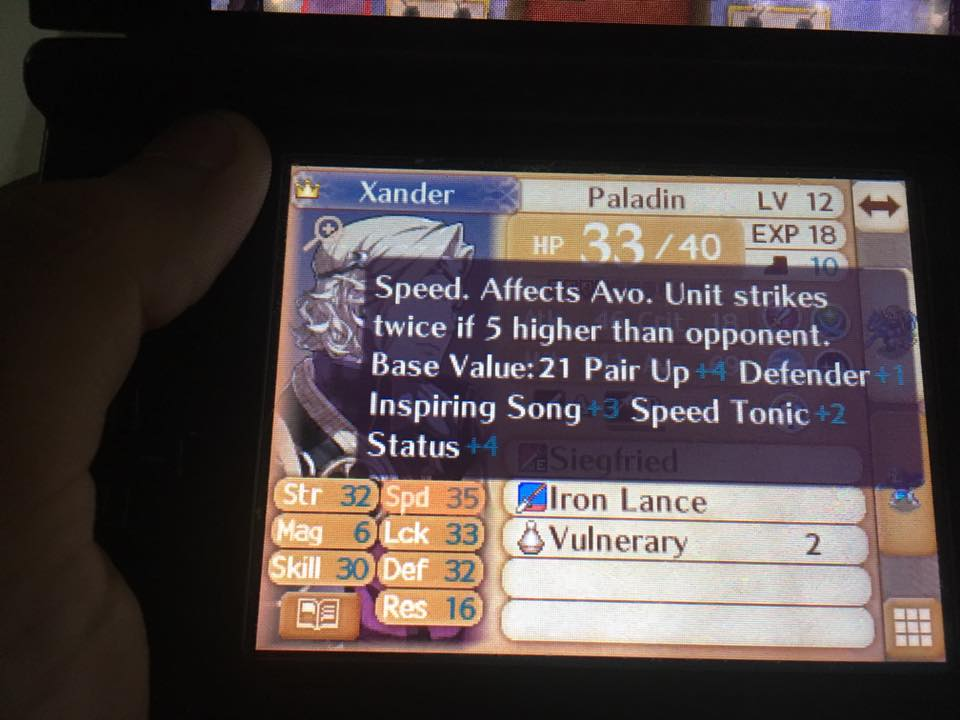


                                That Xander has + 14 Speed in addition to being fed 3 Speedwings prior that particular level. That’s insane! I had absolutely zero problem with Xander getting a speed debuff because he’d still be fast enough to double attack virtually every enemy on the map. When I initially uploaded this picture onto my Facebook profile people were pointing out that there were still other things I could do to boost Xander’s speed which further proves my point at how ridiculously easy it is in Fates to boost one’s stats.

                              
                                Once you figure out how to properly boost your character’s stats debuffing loses most of it’s bite. In other words, instead of debuffing preventing stat-stacking it encourages it because the game provides no other alternatives to dealing with it. I would still prefer to keep debuffing in future installments, but it’s in serious need of some polishing.

  • The first thing I would do is give debuffs the power to instantly nullify stat boosts. Going back to the example of my Xander, if he gets hit by a Seal skill or any Hidden Weapon his + 14 speed, along with all his other stats boosts, should vanish and instead be replaced with whatever the debuff was supposed to be. This would do a better job of “juggernaut prevention” since boosting your best character’s stats would no longer be a guarantee to victory.

  • The second thing I would do is make the debuffs effect last for a shorter period of time. Maybe instead of recovering by 1 per turn you could recover by 2 per turn. Another idea would be to make them only last for one phase. This would still make their effect sting, but it wouldn’t screw you over forever.

  • The last thing I would do is provide skills and items that undid the effects of debuffs. Giving some units access to skills that make them immune to debuffs give them a niche since debuffing would be something you’d rather avoid. How about a staff that undoes the effects of debuffing? That would encourage the player to continue moving forward.


                             Overall: Debuffs are a cool idea that have a lot of potential, but their current execution in Fates leaves room to be desired. With a few tweaks and some extra polish I think that debuffing could live up to its full potential.


                            Weapons: The last thing I wanted to bring up here is the weapon system. Fates made some bold changes to the weapon system and I think it’s worth talking about to see if these changes helped or hurt the game. First, the positives:

  1. Hand Axes & Javelins got nerfed: Hand Axes and Javelins have had this coming for a long time now. 1 - 2 range weapons are really good. They can dish out free damage without fear of a counterattack and they also let the player defend themselves during the Enemy Phase. Fates came along and gave the player a sufficient reason to NOT use these weapons. It’s about time.
  2. Bows don’t suck: Another problem with having 1 - 2 range weaponry is that they  trivialized bows since they had the same range as bows without the drawback of them. Well now javelins and hand axes have HUGE drawbacks that bows don’t have. For starters you can actually double attack with bows. It’s a really nice change of pace

  1. Weapon effects: The biggest change to the Fates system of handling weapons is that the usefulness of a weapon is determined by what kind of effect it has. This forces the player to put in more thought and effort outside of “should I use a weapon now or wait until later to use it”? It opens the door to a lot of new possibilities and I think it’s a great idea.


The Negatives:

  1. Lack of an incentive to use a higher rank weapon: One particular habit that I have across all three Fates installments is that I rarely use a weapon whose rank is higher than a C rank. Why? Well most weapons with higher ranks come with severe drawbacks. Here’s a small list of examples:

  • Silver weapon debuffs stack continuously and it takes a while for the player to recover.

  • Some A or S rank weapons literally halve your strength / magic which means that your usage of these weapons is extremely limited. The strengths that they offer usually don’t counterbalance this.

  • Wakizashi / Spear / Tomahawk: 2 range, can’t double attack and they make it easier for the enemy to double attack you. Why should I use them again?

  • Excalibur / Pursuer: Both of these weapons come with the “follow up attack speed +5, enemy’s follow up attack speed +5”. What exactly is the point of that? It doesn’t help you double attack since the enemy gains the exact same advantage that you do. In fact, I still don’t understand why Fates chose to change the way double attacks are done. Was there something wrong with the old way of doing things? If there is I’m not seeing it.

                   I could keep on listing examples here but I won’t. Needless to say some weapons go overboard in providing disadvantages to the wielder. Sadly some of them are C rank or lower. 


  • Lack of a disincentive to use Iron, Killer and Prf Rank Weapons: Iron and Killer weapons have no debuffs. This means that you can keep on using them however many times that you want and there’s no drawback. I know which weapons I’m using. Not only that but Killer weapons come with the added bonus of dealing x 4 damage when a crit activates. That’s insane! X 3 is already powerful enough, but x 4 more or less ensures that whatever you’re trying to kill will die. Then we have Prf rank weapons which boost stats AND provide 1 - 2 range without any penalties. This basically means that these units almost never have a reason to use any other weapon. Fortunately theseI s are pretty few and far in-between but still.


  • Forging exists in a game where weapon durability does not: I know that the game tries to balance this out by making the forging system convoluted but it still bugs me that I can forge an Iron weapon or a Killer Weapon and that weapon will pretty much laugh at over 90 % of all the other weapons that Fates offers to you. Not going to lie, I’m not a fan of the forging system in any of the games where they exist since forging just lets your powerful units become all the more powerful. What’s worse is that in games like Shadow Dragon or Awakening you can forge Brave Weapons and weapons that deal effective damage (like the Wing Spear) and then you get to watch your units cheese entire maps because of it. 


                                        Overall: I like weapon effects, but the execution here needs polishing. I think John Barkmeyer’s idea of making different weapons perform different functions and be good at different tasks is a better way to accomplish this. I also think that debuffs should never be powerful enough to completely disincentivize a weapon from being used.

                                    Something I’d like to point out is that the successful elements of the Fates weapon system have more to do with weapon effects than the lack of weapon durability. Theoretically speaking you can have weapon durability and weapon effects going on at the same time. I wonder what a hybrid system would look like.

Saturday, November 12, 2016

A Further Look Into Conquest’s Gameplay Part 1

                         “Oh boy! Here we go again. Grant is writing about Fates. He’s going to whine and complain about every single little thing! Ugh!”

                           Given my last post about Fates I can understand why some people might not want to read this but I need something to take my mind off of...recent events. I think we all do. More importantly, this review won’t be entirely negative either. In fact, there are a lot of wonderful things about Conquest’s gameplay that deserve to be praised. On the other hand, it’s not the perfect shining paragon of Fire Emblem gameplay that some people make it out to be either. It does have flaws and those deserve to be talked about too.

                           Before I get into them let me explain some things. This is the third time I’ve played through Conquest. I’ve beaten Hard / Classic twice and this recent playthrough was on Lunatic mode. This playthrough was designed to help get my mind off of work and school which it did for a little while. More importantly I also needed to test some of the observations that I had made in the previous playthroughs. Some observations turned out to be correct while others were completely wrong.

                        Before I begin I highly recommend reading Blazer’s review of the game:http://www.feshrine.net/forums/index.php?showtopic=8470

                                       Blazer imported the game long before most of us got the chance to play it. What surprises me is how much I still agree with the points that he’s made 3 playthroughs and a long review later. I’ll also be quoting from him too from time to time.

Let’s start with:

The Map Design
When Conquest designs a map well, it designs it very well. When Conquest designs a map poorly, it designs it very poorly. What are the good and bad elements of Conquest’s map design?

  • Enemy Unit Positioning: Conquest is a poster child for enemy unit placement. Enemies tend to travel in groups and formations which are designed to take advantage of the new Dual Strike feature. They’re usually placed in such a way that makes the player think about how they’re going to approach a certain situation. Conquest is one of the few games in the series where literally one step in the wrong direction can cause a restart on the part of the player. The only other game I can think of where positioning is THAT important is Fire Emblem 12 and even then Conquest might still have the edge due to Dual Strike.

                       Something that both games do really well is that whenever you attack one enemy chances are you’re in another enemy’s range which forces the player to take multiple variables into consideration when approaching a certain situation. That’s a really good thing to do and I hope that future Fire Emblem titles take after this example.

  • Reinforcement Placement: Another element of Conquest’s map design that’s done particularly well is its reinforcement placement. Reinforcements work as an anti-turtling incentive and they usually are placed behind the player, forcing them to play faster. There’s usually enough enemies to where they can pose a serious threat to the player. 

                      
                        Another major positive for Conquest is that they got rid of ambush spawns. That is something I will congratulate Fates for: It got rid of Ambush Spawns. I’ve been thinking about making a list of 10 Fire Emblem mechanics that I’d like to see more of in future titles and 10 Fire Emblem mechanics that I’d like to see never see the light of day again. Ambush Spawns is toward the top of the latter list. They really don’t add much value to the overall gameplay and they really do come across as unfair. Overall, Conquest is proof that with the right timing, and with the right creativity, you can make end-turn enemies challenging while also being fair.


  • Varied map objectives: This speaks for itself but it is really nice to see a variety of map objectives here. It really does add to the spice and flavor of the game.

  • Dragon Vein / Map Gimmicks: Dragon Vein is an example of a mechanic that is a good idea on paper but was poorly implemented in the game. Certain chapters, like Chapter 8 & 21, do a good job of having Dragon Veins add to the strategy of a level. In Chapter 8 it adds tactical options and additional routes to take when trying to beat the map. Chapter 21 has enough of them spread out over the map, but sparingly enough to where you the player have to use them intelligently.

                           Then we have Chapter 24’s Dragon Vein which is so intrusive and in your face that beating the chapter without it seems darn near impossible. Chapter 17’s map (the ninja den level) is a tad too clunky at times and can just be ignored. I’ll admit that during this past Lunatic playthrough I did end up using it and it helped me beat the map. However, that hasn’t been my experience during my past two playthroughs though and I still think that the designers should have taken more time to polish the actual gimmick.

                                Then we have other map gimmicks like the pots on Chapter 12. Chapter 12 gives a few too many random effects for the different pots. I’m never able to keep track of what they can do despite the explanation given in the box of text at the beginning of chapter. I think it would have been better if the designers had simplified it a bit and made it easier to follow.

                                   Then we have the infamous wind pillars in Chapter 20. As I’ve stated before in my Revelation review the wind pillars are extremely counter intuitive here. Either you know how to use them to your advantage and you cheese the level, or you don’t and the chapter obliterates you. For me the worst part of this is how the only thing I have to do is get my entire army inside of the wind pillar that will take me to the top. I don’t have to do anything except sit there and ignore the vast majority of the map. The wind pillar will take my entire army up toward Mr. Fuga where I jump him and then seize the level.  Before that though we have the really stupid fox illusions which serve no purpose other than to drag out the chapter and give the foxes an advantage over the player. 


      Overall
                             One initial observation that I had that I still stand by is that Thracia 776, Fire Emblem 3 Book 2 and Fire Emblem 12 have better map designs than Conquest. Outside of those 3 games I’m not sure if any other Fire Emblem game measures up. I’ve been told that Binding Blade’s map design is better, although I’m still unsure about how I feel about that. Even if we go along and acknowledge that Binding Blade’s map design is better than Conquest’s that’s only 4 games that beat it out which is an impressive accomplishment.

                              The focus on strategic positioning adds a lot to the game. The way this game handles enemy reinforcements is also superb. Unfortunately Conquest is held back by its map design in the later portions of the game. It feels like it over relies on Dragon Veins and other gimmicks in order to come up with new and interesting maps. Most of the time they don’t work and take away from the strategy and design.

                              I think Blazer hit the nail on the head when he said this as his final conclusion about Conquest’s gameplay: “An enjoyable and challenging game, with some bumps and flaws that stopped it from being nearly as good as it could have been. With some more polish and some less gimmicky features, the main gameplay of the game could have been one of the best in the series. It often felt multiple steps up from Awakening due to the variety of chapter goals, more focused ideas, and increased balanced, but it also felt like it completely failed in some areas.”

                              In the end I think Conquest deserves to be put in the “Top 5 Best Map Designs in the Series” list as it does more good than bad. The map design is by and large of the better aspects of the game.

______________________________________________________________________


  • Difficulty Scaling: Something that shocked me during my playthrough of Lunatic mode was the fact that it didn’t feel like it was that much harder than Hard mode. For the vast majority of the game the only difference I could see was that there would be an extra Hex Rod added here, a few more enemy reinforcements added there and that enemy mooks are granted more skills. On the one hand I applaud the creativity but on the other hand that still doesn’t change the fact that most of the time it didn’t feel like I was playing a harder difficulty setting. The lack of stat inflation (combined with the fact that I got better at the game itself) really made Lunatic mode feel like a fan hack of Hard mode. Normal mode doesn’t sound like it’s all that much more difficult than Hard Mode based off of what Blazer mentioned in his review. 

                         The difficulty of each chapter felt wonky and inconsistent. Some chapters could totally be breezed through while other chapters felt like I was bashing my head against a brick wall and then there were some chapters that were somewhere in between. That reminds me of what Radiant Dawn used to do only instead of having entire sections of the game be this way this is what I had to deal with on a chapter by chapter basis. Here’s a list of all the chapters and how easy / hard they were for me:


Easy Chapters
  • Chapter 6: It’s incredible what an appropriate Dual Strike can do for you here. I managed to even kill Lobster Lord here. Sakura was the only character who survived.

  • Chapter 8: I watched Mangs’ walkthrough of Chapter 8 and it made the map so much easier for me. An Effie with a Strength tonic can kill mages in 1 hit with a Javelin and a properly overleveled Corrin can utterly wreck Flora. The boss wasn’t even all that challenging. I totally managed to visit 3 houses with little to no problems.

  • Chapter 10: This level’s difficulty on Lunatic is over-hyped to the extreme. Wyvern Rider Corrin with a B rank Jakob support can double attack the Pegasus Knights in this chapter. I was able to visit all the houses just fine and kill both Oboro and Hinata. The only I haven’t done yet is kill Takumi on this chapter. Oh well.

  • Chapter 14: Just have a flier fly around the entire map. A Camilla with an extra move pair-up and an Azura song can kill the Enfeeble staff Maid on the first turn. Combine Camilla with Wyvern Rider Corrin and I was able to gang up on the boss and beat the crap out of him.


  • Chapter 15: Another victim of Dual Strike. The enemies in this chapter were pretty easy to kill. I could have beaten this chapter sooner if not for the fact that I wanted that dropped Speedwing from the Hero boss.

  • Chapter 17: Note to self: Wyverns wreck ninja. Most of the enemies in this chapter couldn’t even deal damage to me. Saizo is strong enough to where his survival usually wasn’t much of a concern for me. Even Kotaro was easy to hit, which was weird considering how much of a pain in the butt he was in previous playthroughs.

  • Chapter 19: This chapter’s RNG was more punishing than the furries themselves. There were a lot of times where I could double attack the furries with either attack resulting in a 1 Hit KO but yet still miss. Also, the presence of Beastbanes nearly rendered my horseback units useless. In the end I just paired up Wyvern Rider Corrin with Effie, gave Corrin the Beast Killer and more or less had Corrin solo the map. When a map punishes you for using multiple units, but rewards you for only using one you know you’ve screwed up big time.

  • Chapter 20: Again my age old strategy of “just sit on a wind pillar and let that carry you up toward Mr. Fuga while ignoring the rest of the map” worked spectacularly.

  • Chapter 21: Pair up Corrin with Camilla, give them both healing items, have them fly north in almost a straight line and beat the chapter in about 3 - 4 turns. Lame.

  • Chapter 25: All I had to do was give Corrin Swordbreaker and a Dual Club and Lobster Lord could not hit me at all. I landed 2 critical hits and activated Dragon Fang once within the span of a few turns. The ninjas with Inevitable End can all be ignored which means that planning ahead to give certain units Shurikenbreaker was a complete and utter waste of time.

                    
  fma.png


Really Difficult Maps
  • Chapter 9: That extra Enfeeble staff caught me off guard. Effie got curbstomped by those Spear Fighters. Also, that Archer with Shining Bow really pissed me off. Once I figured out a strategy for dealing with the archer and the Enfeeble staff the map became easier. Still though, holy crap!

  • Chapter 12: There’s a special level of Hell reserved for Archers with Lunge. Also am I the only one who thinks that giving Ninjas a weapon that deals effective damage against Armor Knights is dumb? It was tricky dealing with the center section of the map. Ended up beating the chapter by giving Camilla a Dual Club and landing a critical hit on Lobster Lord for 3 %.

  • Chapter 16: I was really surprised that this chapter gave me so much grief considering that in my last playthrough I beat it with little difficulty (in about 4 - 5 turns). It feels like the enemy density went WAY up. Also those freaking Sorcerers could hit like a truck.

  • Chapter 22:  Like Chapter 16 before it this one really wasn’t all that bad before but for some weird reason I had a hard time with this one. The huge influx of enemy reinforcements combined with the fact that Hana activated Rend Heaven in every single encounter that I had with her really caused a lot of restarts.

  • Chapter 24: OH HECK NO! I freaking hate this chapter with a burning passion. It feels like a pseudo route map in a seize’s body. The Dragon Vein feels way too in-your-face and trying to beat the map without it was impossible. The awkward positioning of the Pegasus and Kinshi Knights made life miserable as well. In my opinion this map would have been way better off if there wasn’t an intrusive Dragon Vein right there. Oh yeah, they gave Azama an extra Hexing Rod, because...reasons. Then they made Hinoka’s avoid a tad too high. Here’s what I wrote after beating the level:


            So after restarting about a trillion times I finally face Hinoka in Conquest Chapter 24. My entire army keeps trying to hit her, but with very little success. I finally manage to whittle her down to 9 HP. Meanwhile hordes and legions of Pegasus Knights are breathing down my neck.

It's literally a do or die situation. If I don't seize this turn I will have to restart again for the one trillion plus one time. My only hope is to have Jakob attack Hinoka with a Hunter Knife. He has a 65 % chance of hitting her. If the attack connects then she dies. If the attack fails then she 1 Round KO's him and I have to restart anyway.

I go for the attack knowing that there's a good chance that I'll have to restart again. The attack miraculously lands. She dies and the goon that's Dual-Guarding her lands in her place. I get Azura to sing for Xander. He obliterates the goon while Elise goes in to seize.


HALLELUJAH! I FINALLY BEAT FREAKING CHAPTER 24! slougihperigubq394t7h0q397gh97ghaeo89ghpaw94t0w47ghpaw49htghp;woefh09w7fhp9ehrt0aw84hgpaer9hga9wph!!!!!!!!!!!!!!!!!!!!!!!!!!!!!!!!@@@@@”


                       Never again Conquest. Never again.


  • Chapter 26: You want to know what’s worse than giving the boss Staff Savant? Giving every flipping Maid Staff Savant. A 10 range infinite use Freeze staff is easily one of the most annoying things I have ever dealt with. Oh yeah, then Iago was given the Hex Rod because why not? The reinforcements in this chapter are more numerous, oh yeah Heroes all have Counter so attacking them directly is a bad idea and they all have Wyrmslayers. Then the game decided to give more of its Generals Beast Killers in order to punish your Horseback Riders some more and Hans is stacked to the brim with extra skills. Did I mention that infinite use Entrap and Hexing Rod staves really suck?


In-between maps
  • Chapter 7: This map gets significantly easier once Corrin is capable of double attacking everyone. However, the Dual Guard Faceless is tough to beat and that freaking Seal Speed is a pain in the butt. Oh, and this map made me HATE Grisly Wound. The boss’s Wary Fighter threw me for a loop too. Probably would have beaten this map faster if I didn’t try as many reckless strategies.

  • Chapter 11: Awkward stair gimmick is awkward. More importantly not paying attention to the enemy skill set threw me off a couple of times. The second to last room really threw me for a loop since the enemy density seems to be greater.

  • Chapter 13: The biggest challenge for me came from the Dual Guarding Wyvern Riders with Armor Knights. Also, having mages try and charge me while Charlotte and Benny show up right in their way did not make life fun for me. Once I got rid of the enemy Pair-Ups, Takumi and Reina the rest of the map was a piece of cake. 


  • Chapter 18: Not paying attention to all the enemy weapons and positioning got me in trouble several times. I almost had to restart from the enemy reinforcements. Fortunately that wasn’t the case, but still. Got all the treasures and once I dealt with the lower half of the map the rest was “elementary”.

  • Chapter 23: Completely avoided fighting the Basaras and Archers and just Pair-Up dropped my army near the stairs (took me a while to figure that one out). Had trouble figuring out a way of dealing with the ridiculous hoard of enemies at the top. Ended up playing a game of hit-and-run with the awkward stair gimmick. After killing those schmucks off dealing with Taco-shooter was a piece of cake.


                       So here’s the breakdown for this playthrough: 10 easy chapters, 5 chapters that are neither too difficult nor too easy and 7 difficult chapters (I’m including the Endgame as well).

                         Going back and re-reading Blazer’s review also showed me that perhaps Normal mode isn’t all that different from Hard mode’s difficulty either. Here’s what he said:

                          “The enemies stats tend to be rather high, especially later on. At one point the enemies' stats and levels increased and they were just as strong if not stronger than me. End-game enemies felt like bosses in other games, and it was extremely difficult to win fights without resorting to my strong units doing most of the fighting, which would only put the weaker units behind even more.

This might be ok on lunatic or even hard, but I was playing on Normal mode and quite frankly, I felt like if I didn't resort to strategies like turtling or using only my good units, I would be screwed over. I get that they were trying to make it challenging, but the challenge was inconsistent: sometimes it was due to gimmicks, other times it was due to a combination of map design, unit design, and unit placement (good), and other times the enemies were just too strong in quality and quantity and there was little I could do strategically to take it, because simply put, the numbers were against me.”


                                If this is something that can be said about Normal mode then I find that to be a problem too. Failing to change enemy stats (which is what it seems like the designers did here) resulted in a difficulty curve that I find overall disappointing. It seemed like Conquest went the exact opposite route of Awakening. Awakening’s difficulty curve is INSANE with Hard mode being too easy and Lunatic / Lunatic + being too ridiculous. By contrast Conquest doesn’t do enough to differentiate between the difficulty modes. It’s nice that they tried something different, but in my opinion that didn’t ultimately work out.

                              I also consider Lunatic mode of Fire Emblem 12 to be more challenging than Conquest Lunatic mode and I also think that Fire Emblem 12 is still the poster child of how to do difficulty scaling right. I think my ultimate take away from this is that in order to do difficulty scaling right you need to do multiple things to make a chapter harder. For me it seems like you need to:

  • Inflate enemy stats: (This is something that Fire Emblem 12 did right and it worked)

  • Add appropriate skills: (NO POWERFUL ENEMY EXCLUSIVE SKILLS! In my opinion this gives enemies too much of an advantage and there’s usually little to nothing that the player can do about it. However, there are plenty of times where Conquest gets this right and I think it’s something to consider when designing future games. I’ll go more in depth in a future post about this.)


  • Increase enemy density when appropriate: (This is something that both FE 12 and Conquest get right and it does work in making the chapter more appropriately difficult.)

Reduce the resources at the player’s disposal when appropriate: (I’ll touch on this topic in later posts, but Conquest gives the player more resources than we’ve been led to think. It really does make the game easier. Fire Emblem 12 does a better job at this although only by a slight margin.)

Monday, October 3, 2016

Analyzing Chapter 7 Binding Blade

                          
                               So here’s a chapter that a lot of people consider difficult. In fact, a lot of hardcore ltc veterans consider this chapter to be either the hardest or one of the hardest chapters in the game. Whichever side of the spectrum your opinion may be it’s generally agreed upon that this chapter is fun to play (and also challenging). So let’s take a look at this map shall we?


  •                                   Enemy Unit Placement: This map begins with wyvern riders at the top who have high range and will threaten the player if not appropriately dealt with. These wyvern riders are pretty tough. Then there are several cavaliers who appear lower on the map, designed to be more-or-less wyvern knights without wings. They’re not as tough but their high movement still means that you have to watch out for them. There are several Armor Knights planted near the enemy villages that help to effectively slow down the player and they work as functioning walls for archers to shoot behind.


  •                             Terrain: This chapter gives you two ways to approach the map: The first one comes through the gate north of the shop while the other path is near the treasures at the far right hand corner of the map. Speaking of treasures, this map has two of them in the right hand corner in addition to multiple villages. Normally this would be put under “Anti-Turtling Incentives” but in this case they aren’t being threatened by a brigand or a thief so there’s no rush to get to them first which means that they don’t count as anti-turtling incentives. However, obtaining the treasures does make it easier for both the enemy to box you in and for the player to create chokepoints in order to deal with enemy units. There’s also a really nice spread of forest tiles strewn throughout the center of the map that the player can take advantage of in order to deal with enemy units.


  • Anti-Turtling Incentives: There are two anti-turtling incentives in this chapter. The first comes in the form of enemy reinforcements:

                                    At the end of Turn 10 enemy cavaliers will show up behind the player encouraging them to play faster. On Hard Mode these reinforcements will also show up on Turns 15 & 20. After crossing a certain point on the map you get more enemy reinforcements (2 soldiers, an archer and a mage) that will help protect the boss. This adds some additional strategy to the chapter since the player will now have to think about how they want to deal with these reinforcements. 


                                     The second comes in the form of Zealot and Treck. Keeping these guys alive can be pretty tricky on Hard mode. They’re threatened by competent enemy units and the possibility of them dying before you reach them is real. Zealot is pretty good so recruiting him is well worth the effort.

                                Overall: This map’s not bad. It gives you plenty to do, encourages the player to play faster and throws a couple of surprises at them.