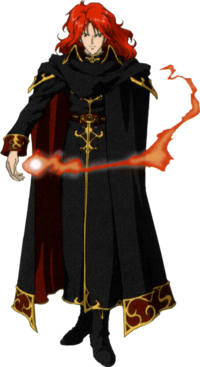
Monday, September 5, 2016

Fire Emblem 4 - Genealogy of the Holy War Part 5 - The Flaws in the Gameplay


                         Gameplay:  So like my Radiant Dawn review I’ll start first with the negatives here before going onto the positives. No discussion of Holy War’s gameplay can occur without addressing the giant elephant in the room: The map size. For those of you who don’t remember I’ve brought up a “Top 5 Fire Emblem games with the Worst Map Design” list in previous reviews. However, I only mentioned four Fire Emblem games that would be on that list (Gaiden, Awakening, Fates: Birthright and Fates: Revelations). Well guess who the fifth member is? That’s right, Holy War is the fifth and final member of the “Top 5 Fire Emblem games with the Worst Map Design”. Here’s an idea of what that list looks like:

  1. Gaiden
  2. Fates: Revelations
  3. Awakening
  4. Holy War
  5. Fates: Birthright

           ^ This is what that list looks like in my opinion, although that order could easily change, but for now those are the five games in the series that I consider to have the worst map designs. Being on a list like that is a huge criticism of Holy War. You might be wondering ‘what makes the map designs so bad’? Well I’ll tell you:

  • The giant size exacerbates the disproportionate advantage that high movement units have over low movement units. Objectively rating units like Levin, Sety and Shannan hurts because I have to dock points from them because of this.

  • Half of the maps in the first generation require backtracking which is tedious and adds nothing to the strategy of the game.

  • Most of the maps tend to have dense terrain that slows the player down for no good reason.

  • There isn’t as much thought and effort put into enemy unit positioning.

  • Enemy armies tend to mostly consist of either one unit or one weapon type so it’s easy to figure out how to defeat them. What’s worse is that most enemies are pretty easy to destroy so you don’t even have to put THAT much thought and effort into destroying them. 


                        Those are the criticisms that I can think of and they are all valid. I can certainly understand why Holy War’s maps get the hatred that they do, however I don’t agree with throwing the entire game under the bus because of it. On a personal note the map size doesn’t bother me. I can objectively criticize it, but unlike the other four games on the “Worst Map Design” list I can ignore the maps here because of the fact that they add to the size and scale of the game’s story. In Holy War the giant maps make me feel like I’m in an actual country fighting against enemy armies in epic battles. The only other games that give me that feeling are Radiant Dawn, Binding Blade (sometimes) and Thracia 776 (sometimes). That’s a pretty epic feeling and for me it adds to the experience. Also, let’s not forget a point I made earlier on in this review:

—And that’s why the maps became large?
Kaga: Indeed. We’ve made the maps that large because the world itself was broadened. The previous map size made it feel like it was a limited-scale war, and even if there were events here and there it didn’t make you feel like it was a large world. Through the system we used this time around, many of those large regions can exist at the same time, and influential individuals of each region can move independently… I thought it’d be able to express such dramatic developments. We also made it a long story going across two generations – parents and children – with that in mind. Feeling the movements of a large-scale story while letting the player shape the future depending on their playstyle were points we tried to implement.”


                   There was a clear cut thought process going on when Kaga and the other developers made Holy War and in my opinion they achieved their goal. Unfortunately most players don’t think along those lines and clearly have different priorities so the effect of these big maps got lost in translation. Still, I will always appreciate that element of the big maps, even if most other players don’t. Plus this point gets repeated so often that it’s just beating a dead horse over a mountain of dead horses. There’s nothing new to say and the way most people talk about it you’d think that map design was all they cared about. It’s fair to criticize the maps, just remember that map design is not all there is to a game. 


                        The worst part of exclusively focusing on Holy War’s map design is that it takes the focus away from some of Holy War’s other design flaws. I hate doing this, but for the sake of fairness I must talk about the other flaws in Holy War’s mechanics. Flaws such as:

  1. Pursuit: Needing to have a skill in order to double attack is a dumb idea. As much as I love Holy War even I have to admit that I’m glad this idea didn’t get passed down to the other games in the series. The battle formula for double attacking is also dumb. Needing to have only 1 more attack speed than your enemy is not a good idea as it makes doubling attacking too easy to pull off.

                       However there is a myth going around that I’d like to dispel. The myth states that not having Pursuit instantly makes a character unviable. On a surface level this would seem true but the problem with this is that there are a considerable number of units in Holy War that are not only viable, but are some of your best units and they don’t have Pursuit. Take a look at some of your best units in the first generation: Lex, Levin, Sylvia, Cuan and Ethlin. None of them have Pursuit and yet they’re basically you’re best non-Sigurd units. The second generation is harder to talk about since you can manipulate the pairs so that over 90 % of your army has Pursuit but I would like to point out that Leif doesn’t have Pursuit before promotion and Levin!Arthur never gets it and they’re considered to be some of your best units in the second generation.

                     
                       Now I suppose a potential counterargument is that all of your worst units in both generations tend to not have Pursuit so there has to be at least some element of truth right? Well for the sake of argument let’s say that Ardan, Diadora and Dew all had Pursuit. Would that magically make them great? My answer would be no. Ardan’s biggest disadvantage would be his incredibly low movement in a game with notoriously large maps. Plus he’s Armor Knight, they’re a class notorious for being slow. He probably wouldn’t even double attack that much anyway.

                     Diadora’s main problem is her lack of availability. She’s only around for 1 full chapter plus the tail-end of Chapter 1. She’d have to be as OP as the laguz royals in the Tellius games if she were to be anything below bottom tier and giving her Pursuit wouldn’t be enough to fix that problem. Plus she doesn’t have a horse.

                          Dew would definitely benefit the most from getting Pursuit since he’s a thief, but his strength is so crappy that I’m pretty sure a toothpick could do more damage than this little twerp. Plus he doesn’t have a horse.

                  So it’s definitely possible to be an awesome unit without Pursuit. However, it does put you at a disadvantage that frankly shouldn’t be there.


  1. The lack of trading: This is another flaw that I see people point out. I’ll admit that it’s tedious, but this one never bothered me all that much. I can see why other people wouldn’t like it though.


  1. Poorly designed weapon stats: Take a look at all the magic swords in this game (http://serenesforest.net/genealogy-of-the-holy-war/inventory/swords/) Notice a pattern? They all have the stats. They have the same might, the same weight, accuracy and worth. They’re basically the same weapon. Okay, the Runesword saps HP and has a fifth of the uses that the other ones do, but HOLY CRAP! Whose bright idea was that to give them identical stats?

                                It’s even worse with tomes (http://serenesforest.net/genealogy-of-the-holy-war/inventory/fire-thunder-wind/). Same might, same accuracy, but different weights. Why is this worse? It’s worse because Holy War’s attack speed formula subtracts the weapon weight directly from the wielder’s speed. Formulas like this give a huge advantage to weapons with lower weight. So if their might and accuracy are the same, then basically wind tomes end up being the best anima tomes since they hit just as hard, and are just as accurate, while giving fewer attack speed penalties. I love Holy War, but even I have to admit that that’s pretty stupid.

                      Axes and lances have absurd weights whereas swords are practically made of feathers by comparison. Why does a Brave Axe weigh less than an Iron Axe? It doesn’t make any sense at all. Also a Silver Axe has 22 might (http://serenesforest.net/genealogy-of-the-holy-war/inventory/axes/). Not even kidding. That’s a higher might than most game’s regalia. 


                     Speaking of regalia I suppose you want me to criticize how strong this game’s regalia are right? PLOT TWIST! I actually LOVE their sheer power. 30 might, + 10 - 20 boosts and sometimes accompanied by giving an additional skill? HECKS YEAH! Boy do I love these mother flipping regalia in this mother flipping game! On a completely personal note, I love powerful regalia. I’d much rather have a game go the Holy War route than the Fates route when it comes to regalia. It’s a pet peeve of mine to see the highest ranked weapons in a game be lame or underwhelming. I won’t go into another anti-Fates tirade, but let me just say that I am not a fan of the way that game handled its Regalia. There’s just something about roflstomping entire armies that gives me such a good feeling whenever I play this game.

                          So tl;dr version: This game sucks at handling weapon weight. There’s one more flaw I’d like to point out before talking about the cool elements of Holy War’s gameplay, it’s formula for calculating critical hits: 


                          “Critical rate (with Critical skill) = Skill + Weapon Kills bonus + Combination bonus [%]” (http://serenesforest.net/genealogy-of-the-holy-war/miscellaneous/calculations/

                       That’s right, luck is not subtracted from a unit’s critical hit rate. To be fair you could probably counter this point with the fact that critical hits either require a skill, weapon kills or the lover/sibling crit bonus which all happen in limited amounts anyway. Still, I’m not a fan of this particular calculation.

Fire Emblem 4 - Genealogy of the Holy War Part 4 - The Playable Characters

 
                         The Playable Characters: So the villains are impressive, but what about the heroes? For a game that came before the invention of support conversations this game does a good job of getting its characterization across with what few lines of dialogue there are. I’d be lying if I said that this game didn’t suffer from not having support conversations, but what fascinates me is that even without them these characters still come across as more memorable and better characterized than other games that do have supports. 


                              Take Fin for instance. Fin is an example of how to do a loyal knight character properly. Honorable loyal knight characters bore me because it feels like they’re all cut out of the same cloth. They never really get to have their loyalty tested so it feels easy for them to say that they’re “loyal, honorable and willing to sacrifice for their lord. Blah, blah, blah, blah.” Fin, however, gets put to the test. He has to raise Leif and Nanna while also being on the run from the Empire. It would have been so easy for Fin to simply hand over Leif and watch him get skewered by Thracia or Grandbell. It’s also been said (at least in Thracia 776) that Fin often went hungry just so Leif could have something to eat. Fin gets major props from me for being able to survive Jugdral. Freaking Jugdral. He got to live long enough to see Manster united with Thracia and to see Leif become the king. Without Fin, Leif wouldn’t have been able to survive. If you haven’t seen it yet I highly encourage you to watch Mangs’ character spotlight of Fin. It’s well done:


                            Then we have Leif. Leif is awesome. He grows up as a fugitive on the run from the Grandbell Empire. In Thracia 776 Leif has to lead a ragtag army of villagers, thieves along with a few nobles and knights in the hopes of defeating Thracia and the Grandbell Empire. Here are a few quotes about him:
                      
                             “Leif is probably one of the more memorable characters in the Fire Emblem franchise, for a few reasons. He's one of the few characters to play a significant, plot-important and leading or quasi-leading role in two separate FE games. He certainly has one of the more unique experiences of FE lords as the main character of FE5, and occupies the unique place of being a vitally important mainline unit who is not of Major Holy Blood in FE4.


                               Holy s***, it's motherf-ing Leif! Leif is the best character in the series, and that is an absolute fact. Dude was so perfect they said "damn, we better give this guy his own game!"...

                          He is, however, one of the best developed characters in the series. Because he does two things that most units don't do: he makes mistakes and he learns from them. His blunder towards the end is the biggest mistake any FE lord makes except maybe Eirika. But Leif redeems himself, and becomes a better leader afterwards. For that alone, he is a very well written unit.” (Source: https://www.reddit.com/r/fireemblem/comments/3aljgq/character_discussion_fe45_leif/)
                                Also here’s another cool video I stumbled across about Leif that I think you’d all like:


                                 Another cool character is Ayra, aka the original swordmaster waifu. In addition to being hot Ayra’s got a cool character to boot. She was charged with taking care of Shannan while her older half-brother Marricle had to lead Issach on a suicidal mission against Grandbell. She had to fight alongside Kinbois in order to keep Shannan alive. She was so ferocious that even he was scared of her. It’s also interesting to note that Ayra’s so good that she can’t be held back by a bad mate. Even when I did my crack pairings run Larcei still turned out to be great.


                                Then there’s Levin. Levin, in my opinion, is the best example of the Jeorge archetype, aka the secret nobleman who acts like a carefree bard. Levin originally ran away in order to keep his uncles from going after the throne (weird logic I know, but they didn’t start making a move until after he returned to Silesse). When that didn’t work Levin and Sigurd cleaned house and Levin finally decided to become a responsible ruler. Then the Massacre at Barhara happened and Levin was killed by Manfroy somehow (as shown in the opening of Holy War). The Holsety tome, however, is so cool that it brought him back to life, albeit with a significantly different personality. From there Levin served as Seliph’s tactician throughout the second generation and helped Seliph overthrow the Grandbell Empire. 


                Then there’s Shannan. Shannan starts out as a little kid who’s first words involve encouraging Ayra to beat the crap out of Kinbois. You know you’ve got a genuine badboy on your hands when those are his first words. He then is given the responsibility of watching over Diadora in Chapter 3. He fails and feels like utter crap doing so. The Fire Emblem 4 manga makes this even more tragic. In the manga he tries to defend Diadora from Manfroy only to have Manfroy mop the floor with him. Diadora has to save his life and it’s when she does that she lowers her guard down just long enough for Manfroy to brainwash her. Ouch. That must really suck. Shannan has to carry that guilt with him for the rest of his life.

                                  Eventually this little tyke ends up growing up into being one of the greatest swordmasters in Fire Emblem history. He leads the rebellion in the second generation (well he starts it anyway and then Seliph takes over because Seliph’s the main character) and helps Seliph and co. wreck the Grandbell Empire. Iirc Shannan eventually spills the beans to Seliph about his failure to save Diadora during the final chapter of Holy War. Eventually Shannan takes his place as King of Isaach. It’s so cool seeing a little kid grow up into being one heck of an overpowered bad boy. Shannan is awesome. 
 
                          Overall Summation:  I could continue, but you all get the point by now. The playable cast in Holy War is amazing, and they too help make this game the memorable epic that it is. If I forgot to talk about a character that you like in Holy War feel free to bring them up.


 P.S.
                   Oh and before I forget here’s an awesome quote: “House Baldo = House Stark”

Sunday, September 4, 2016

Fire Emblem 4 - Genealogy of the Holy War: Part 3 - The Villains

              Characters: Once again there will be spoilers here so if you haven’t played, or finished, Holy War you have been warned.


SPOILER WARNING!

            Holy War has an impressive cast of villains. 

                Alvis: Alvis gets my vote for “Best Villain in the Series”. He starts off as a guy who gives you a Silver Sword but then proceeds to frame the assassination of Prince Kurth on Sigurd and his family. After letting Sigurd kill of Langobalt and Reptor Alvis lures him into a trap before proceeding to kill Sigurd and his army. Oh did I miss something? That’s right, Alvis stole Sigurd’s wife Diadora and then proceeded to flaunt this fact in front of him too. Let me repeat: Alvis stole the main character’s wife before proceeding to murder the main character. How many villains pull off a feat like that? That is some of the most epic villainy I have ever seen in a fictional story.  What’s even more impressive is that the guy got to take over the continent for about 15 - 18 years after that. He literally won in the most epic way a villain can win. He kills the main character, steals his wife, outplays his treacherous allies and then proceeds to dominate the continent. GG Alvis.

                    But the story doesn’t end here though. After clawing his way to the top he then gets to watch everything he worked so hard to achieve get ripped away from him bit by bit. His empire started off peacefully but eventually the Loputo cult turned it into hell on earth by conducting child hunts and brutally oppressing people. Alvis also had to watch his wife Diadora get murdered in front of his eyes by his son who has now been possessed by an evil book and turned into Fire Emblem Satan. What’s worse is that the son of the man he betrayed is now leading a liberation army that’s tearing the empire apart country by country using the weapon that he gave to his father (the Silver Sword).                       


                   By the time we see Alvis again in Chapter 10 he’s a pathetic, broken mess. He lost his wife, his son is evil incarnate, his daughter has been working with the liberation army that’s tearing down his empire (and at this point is being sent away by Manfroy to be killed off so she can’t oppose Julius) and his empire is being torn apart. Manfroy and Julius tell Alvis to his face that he’s a useless puppet whose usefulness has come to an end. He knows there’s nothing left for him so he willfully gives Seliph the Tyrfing so that Seliph can end his life.

                     This is why Alvis is such a great character. He is both a puppetmaster and a puppet at the same time. He’s a villain that achieved so much and yet died a broken mess. Most villains never get it quite as good as Alvis but in the end everything he worked so hard to achieve comes crashing down on him. Despite all the horrible things he did to Sigurd he still remains sympathetic and three dimensional, which is a really hard feat to pull off. He was a dangerous idealist at heart. He believed that he could bring a peaceful utopia and Holy War wouldn’t be Holy War without him.


                  Trabant: The next best villain on the list is Travant. He’s the proto Naesala. Travant is characterized by the willingness to do absolutely anything to save his people from starvation. He’s a mercenary stereotype mixed in with being a king. He’s cunning and intelligent, willing to stab anyone in the back if it makes life better for the people of Thracia. I gotta give props to this guy for being smart enough to ambush Cuan and Ethlin in the Yied Desert. Not every villain would be smart enough to do something like that. Another major element of Travant’s character is that he doesn’t really care if the rest of Jugdral looks down on him as a bad guy so long as the people of Thracia can put food on the table. He was also willing to raise Altenna as his own child (making him the proto Garon too. Holy crap! Altenna’s the proto Corrin without being a spineless Mary Sue). In the end I do think that Travant is one of the better secondary villains this franchise has produced. 


                              Ishtar: Next on the list is Ishtar. Ishtar is Julius’s girlfriend and the daughter of Blume. Prior to the events of the story she fell in love with Julius before he got possessed. Julius still continued to love her even after he got possessed which explains why she stayed with him (unlike Eldigan who is arguably the stupidest Camus in the series) and it’s easy to see why she’d still fight alongside him. Once she finds out about the child hunts she tries to convince him to stop, but when that doesn’t work she helps Alvis try to bring an end to the child hunts. In other words, she’s a Camus that tries to resist the evil ruler that she cares about.

                           In addition to all that the player is continuously killing one member of her family after another so she has a personal reason to oppose the liberation army. In Chapter 7 you kill her brother, Ishtore, (he’s the guy that looks like a girl that sits on the castle down at the bottom) and then you proceed to attack her father Blume. He lives, but that changes in Chapter 8 when you finish him off for good. In two chapters you’ve killed her father and her brother and then two chapters later you kill her mother Hilda and eventually you’re going to kill her fiance. I’d say that’s plenty of good reason for her to actively fight against Seliph. 


                      Here’s one more quote about Ishtar that I think deserves to be here: “Her father used her as a weapon and her mother used her as a political tool. She was pushed into that position, and not being a very strong individual, she didn't see or was too scared to take her way out.” (Source: https://www.reddit.com/r/fireemblem/comments/2nvgcn/did_i_miss_something_about_ishtar/)

                         Overall, Ishtar is one of the best Camuses in the series and one of the better written villains in the series. She definitely gets my approval.


                     Manfroy: So I had a hard time deciding between whether Manfroy or Gharnef was the better “master manipulator”. They both achieve their goals of resurrecting the Final Boss in addition to bringing back the empire that the good guys have to defeat. They’re both dark mages and they both manipulate A LOT of people and countries.

                     However I think Manfroy comes out as the superior manipulator. Gharnef always accomplishes everything prior to the start of the games, whereas Manfroy performs all his accomplishments in Holy War itself. To me that’s a lot more impressive. There’s also the fact that Manfroy was able to prevent Sigurd from stopping his plans while Gharnef got foiled by Marth and co. not once, but TWICE. I’m also fairly sure that Manfroy’s empire lasted longer. The Grandbell Empire had about 18 years of dominance over Archanea while I don’t think that the Dohlr Empire’s reign lasted that long since Marth doesn’t seem to be significantly older when he decides to fight back. 


                    Why am I bothering to bring all this up? Well my point is that Manfroy is the most successful Gharnef archetype out of all the Gharnefs in the series. That’s not something to sneeze at. Successful villains are more rare than sympathetic ones. Manfroy always stands out to me for just that exact reason. That being said, Manfroy loses points for a lack of character development. We don’t know much about his background or his motivations. Still, he’s effective at being that master manipulator type of character and that counts for something.

                     I would consider those four to be the best villains of the game. Everyone else does what they’re supposed to do but aren’t quite as good as these four, although there’s something creepy about Joffrey Julius aka Mr. Incest Satan. I also have to give it up for Chagall (who I still refer to as “Chagall the Hutt” from my Holy War x Star Wars crossover fanfic. Ah good times) for being a prime example of being phenomenally stupid and corrupt. 

                               Overall Summation: Holy War has an extremely impressive cast of villains. Alvis still gets my vote for "Best Villain of the Franchise" and Trabant and Ishtar score major points for their impressive villainy too. Manfroy may not be developed but he does succeed at what he does far better than any other Gharnef in the series. Without these villains Holy War would not be as awesome as it currently is.

Fire Emblem 4 - Genealogy of the Holy War: Part 2 - The Light Inheritors

                   
                   Another major design flaw that doesn’t particularly annoy me is Holy War’s map design. I will eventually get around to criticizing it in my gameplay post but the reason why I’m bringing it up here is because the plot gives these huge maps a context that justifies their existence. In Holy War you’re usually doing one of two things: You’re either invading an entire country or you’re going from one part of a country to another. The gargantuan maps add to the size and scale of these battles. In this game you actually feel like you’re in a country fighting actual battles against an enemy army which is a pretty cool feeling that adds to the experience for me. Here’s what Kaga’s mindset was when designing the maps in Holy War:

                        “—And that’s why the maps became large?
Kaga: Indeed. We’ve made the maps that large because the world itself was broadened. The previous map size made it feel like it was a limited-scale war, and even if there were events here and there it didn’t make you feel like it was a large world. Through the system we used this time around, many of those large regions can exist at the same time, and influential individuals of each region can move independently… I thought it’d be able to express such dramatic developments. We also made it a long story going across two generations – parents and children – with that in mind. Feeling the movements of a large-scale story while letting the player shape the future depending on their playstyle were points we tried to implement.”


                        For me the big maps succeeded in making the world of Jugdral feel bigger, vast and much more epic in scale. I also agree with Kaga that smaller sized maps tend to give the impression of limited scope. In Holy War the bigger maps successfully portray the grand and epic scale that this game is clearly trying to go for.

                        This game also has great world building. Right at the start the game gives you a long chronology of the events that transpired prior to the events in the game. This little tidbit right here gives Holy War more world building than a good chunk of the other games in the series. What’s even better is that these events get brought up in the events of the game and one of these events even becomes a major game mechanic. (Naturally I am referring to the Holy Blood system) I love little touches like this when the game mechanics and story are intertwined. The chronology also sets up how the different kingdoms were founded too. Also, this game has an extensive family tree


                   Blood ties are very important. Family politics and drama are prevalent. In fact lineage and inheritance are bigger themes of this game than even I came to suspect. Here’s a fantastic quote that explains all of this in detail:

                   “As the title suggests, FE4 deals a lot with lineage, inheritance etc. This is especially apparent when you look at the game's mechanics, but I am talking about how that theme of inheritance plays into the story. The main cast of FE4 consists of characters who are, for the most part, nobles from ancient royal lines, descended from legendary heroes who defeated a great evil. I don't just mean your characters either, most of the enemies are also descended from "crusaders" as they are so called. These descendants, who inherited immense power from their ancestors, enter a huge war, where they have the power to defeat entire armies single handedly with holy weapons. But unlike their ancestors, they did not earn this power by being sworn to a cause against evil. It was literally handed down to them. So while some (like Cuan and Sigurd) use their power to stand up for what they think is right, others (Eltshan) are loyal to a fault and end up on the wrong side of the fight, some (Langobart, Reptor) are greedy and cruel, and use their power to cause unrest, others (Arvis) are dangerously idealistic and more than a little arrogant, and plunge the world into chaos through their attempts to rebuild the world. The story of gen 1 shows that inherited nobility and power do not guarantee that a person will use it responsibly. The legacy of the ancient holy knights is that they would destroy each other.

In gen 2, you see much more of these "inheritors of light" rising to the challenge to overcome the evil in the world. When faced with an ancient demon (Loptyr, very similar to Grima) threatening to take control of the world, the descendants take up the mantle of their ancestors, and become the new crusaders. You still see some fighting on opposite sides, but in the end they are much more united against the enemy, and even among those who you fight, many find their redemption. So the big theme is rising to the challenge of your ancestors, and taking on the responsibility that the world thrust on you.”


                         Yeah even the name for this game ties into the themes that are prevalent here. This game also is one of the few to have an actual calendar. The only other continent that I can think of that does this are the Tellius games though I could be wrong on that.

                        Holy War also has the best plot twist in the entire series. The Massacre at Barhara hit me like a ton of bricks in a way that only 2 other fictional events ever have. This used to be the most disturbing thing I’d witnessed in a story up until I saw the Red Wedding and the Eclipse in Berserk. I remember this scene in Holy War giving me nightmares. Watching Alvis flaunt Diadora in front of Sigurd before proceeding to burn him and his army alive is heart wrenching. 


                        Overall Summation: Despite everything I’ve written here I still don’t feel like I’ve done the story of Holy War justice. For me, the strongest element in Holy War is it’s story. Holy War has the best story in the Fire Emblem series bar none. It’s dark, political machinations give it an edge over other games and I wish that future installments would do something along these lines.

Fire Emblem 4 - Genealogy of the Holy War: Part 1 - A Song of Ice and Fire Emblem


Nickname: A Song of Ice and Fire Emblem


                Plot: In my opinion the strongest category for Holy War is it’s story.  Since most of the people who have read my reviews have played Holy War I am going to dive into spoiler territory. If you haven’t played Holy War yet  THERE WILL BE SPOILERS DOWN BELOW!
>
>
>
>
>
>
>
>
>
>
>
>
>
                             Alright I think that should be enough arrows. Holy War has the darkest plot in the entire Fire Emblem series. In fact I tend to think of it as a 16 bit Game of Thrones, hence the title ‘A Song of Ice and Fire Emblem’. Incest is a major plot point in both stories (Joffrey’s parentage leads to the War of the Five Kings while Alvis and Diadora spawn Julius, which is Manfroy’s plan) and in both stories it has disastrous consequences. Rape is also featured in both stories, although in Holy War it’s only the explanation for how Azel was born and thankfully it’s never shown explicitly. Game of Thrones on the other hand has lots of rape and that show is very explicit. The third  major similarity is that both stories feature TONS of political upheaval.

                               Political upheaval is par for the course in Fire Emblem narratives but Holy War amps this to 11. The conflict at the start of the game features Grandbell getting pissed off at random barbarians slaughtering an allied town which snowballs into a major war. Meanwhile poor Sigurd gets involved with events that go way over his head resulting in him conquering 2 countries and dealing with 2 civil wars (the second civil war involving him eliminating 2 Grandbell dukes). In terms of military upheaval here’s a sample of what I’m talking about:


  • Darna gets slaughtered. Grandbell declares war. King Mananan of Isaac beheads the barbarian leader. Then Mananan gets assassinated before he can bring the head of the barbarian ruler over to Grandbell. Maricle, the crown prince of Isaac, leads the charge against Grandbell even though he knows that Isaac will be destroyed.


  • Sandima goads King Batou into launching a preemptive strike against Grandbell. Said strike leads to Sigurd and co. fighting back which ultimately results in the takeover of Verdane. Meanwhile Eltoshan has to cover Sigurd’s back because Duke Elliott tries to launch a sneak attack of his own against Grandbell.


                              In just the first two chapters of the game you’ve got major political schemes and machinations going on as various dukes and kings kill each other for power. These two conflicts alone set up further conflicts which snowball and escalate into even bigger wars. That’s something I love about Holy War. The politics in the first generation are absolutely crazy!

                             Something that this game does very well is that it feels very distinctively medieval. Fire Emblem is supposed to be Japan’s take on medieval Europe but most of the series only comes across as medieval European in the way that most generic fantasies do. Holy War, by contrast, goes the extra mile to feel distinctively medieval by including some of the darker and nastier elements that were major parts of medieval Europe. Here are all the ways that for me make Holy War more distinctively medieval:


  1. Incest: That happened in real Middle Ages between actual nobility. The thing is, the player could make incest happen between certain characters (for example Claude x Sylvia, Lex!Larcei x Johan / Johalva or just any version of Larcei x Shannan). Unlike Fates or even Awakening, incest is more prominent to the story and serves a function other than to allow the self insert character to have sex with more characters.

  1. The emphasis on cavalry: Say whatever you will about its effect on the balance of the game (in fact I’ll be making a point about it later on in this review) but you have to admit that the huge focus on cavalry is something that makes it feel more distinctly medieval. Cavalry was a big deal in the Middle Ages. Here’s what a quick Google search of cavalry’s impact on medieval warfare brought about:
                      
                               “The speed, mobility and shock value of the cavalry was greatly appreciated and exploited in armed forces in the Ancient and Middle Ages; some forces were mostly cavalry, particularly in nomadic societies of Asia, notably the Mongol armies. In Europe cavalry became increasingly armoured (heavy), and eventually became known for the mounted knights.” (Source: https://en.wikipedia.org/wiki/Cavalry#European_Middle_Ages)

                             Now to be fair, one aspect of medieval warfare that Holy War didn’t incorporate was the fact that archers actually won battles and played a HUGE role in determining the outcome of a battle. Still, that doesn’t take away from the fact that cavalry was also important in the Middle Ages.


            3.  The way kingdoms are set up: The way that the countries in Holy War are set up also feels very distinctly medieval. You have duchies that are under the control of dukes that “possessed large territory and military holdings, and exercised partial autonomy while serving under the Royal Family.” (Source: http://serenesforest.net/genealogy-of-the-holy-war/scripts/script-translation/prologue-birth-of-the-holy-knight/)

                   That’s akin to how medieval societies were set up. While the quoted script is talking about how Grandbell’s government is set up, the rest of the countries in Jugdral are also set up that exact same way. It’s because of this that I can overlook the fact that there’s only one map objective in the entire game. 


            4. People getting burned at the stake: No I’m not talking about the Massacre at Barhara. I’m talking about the background lore that involves the Loputo Clan getting burned at the stake because they were descendants of the Dark God. While the reasoning may be different that is still something that happened in the medieval times. As far as I’m aware no other Fire Emblem game does this.